Brand in advertising: how distinctive cues build memory and meaning
A brand is not stored in memory as a logo file or a list of approved colors. It is reconstructed from linked experiences: a name, a shape, a product, a promise, a buying situation and the feeling of recognition. Brand design works when those cues help the right memory become available at the right moment.
Imagine a running-shoe ad built around a deep green field, a coral sole and a diagonal line that suggests forward movement. The image is distinctive. But distinctiveness alone does not prove that the viewer will identify the advertiser, understand the category or retrieve the brand later when choosing shoes.
A rigorous brand review therefore asks more than whether the execution follows a visual identity system. It asks what the creative is teaching memory, which cues can retrieve that learning, whether those cues belong to the advertiser and whether the intended audience can connect them with a relevant need.
Brands exist as structures in memory
Kevin Keller's model of customer-based brand equity treats brand knowledge as a network of a brand node and linked associations. Awareness concerns the strength of that node. Image concerns the types, favorability and uniqueness of the associations connected to it. This distinction explains why recognition and meaning must be reviewed separately.
A viewer may recognize a swoosh, bottle shape or color combination without being able to state the current proposition. The reverse can also happen: a generic category message may be understood but fail to identify its source. Strong creative builds both routes. It makes the advertiser available and connects it with useful, credible meaning.
"Brand knowledge is conceptualized as consisting of a brand node in memory to which a variety of associations are linked."
Kevin Lane Keller, Conceptualizing, Measuring, and Managing Customer-Based Brand Equity, 1993
Associations vary in strength and diagnostic value. Some are category-wide, such as freshness for toothpaste or safety for insurance. Others are more specific: a founder story, a distinctive sound, a recognizable pack or a particular way of framing a benefit. Brand strategy decides which links should become strong. Creative execution determines whether an exposure actually rehearses them.

Mental availability depends on retrieval conditions
Memory is cue-dependent. People rarely search memory for a brand in the abstract. They encounter a goal or situation: shoes for a first half marathon, a drink for a warm afternoon, software for a dispersed team. These conditions provide retrieval cues. Advertising can strengthen links between the brand and those situations.
Romaniuk and Sharp define brand salience as the brand's propensity to be noticed or come to mind in buying situations. Their work shifts attention from a single top-of-mind score to the range and quality of cues through which the brand can be retrieved.
This has two implications for design. First, an execution needs enough category and usage information to connect the brand to a future decision. Second, distinctive brand cues should appear in a form that memory can encode and later recognize. A beautifully branded film that never establishes the occasion may create familiarity without useful availability.
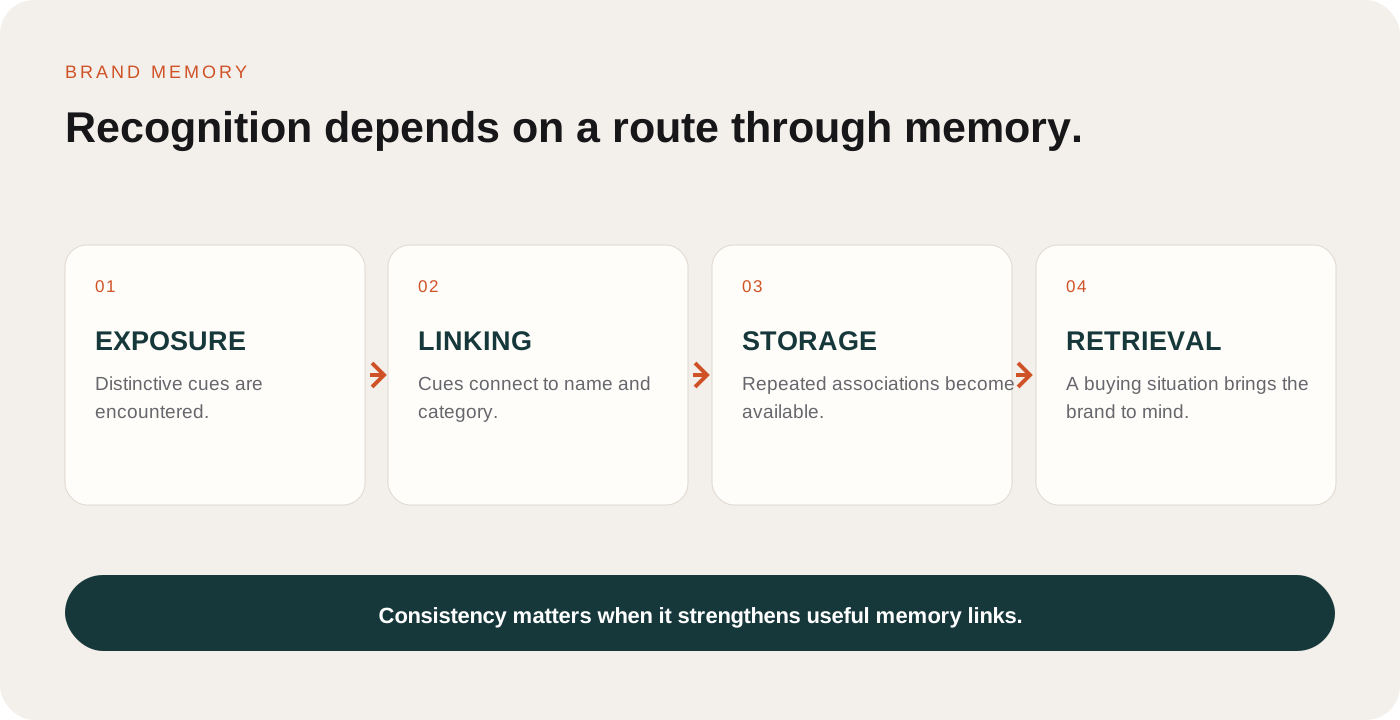
Recognition and recall are different tasks
Recognition asks whether a cue is familiar when it is present. Recall asks whether the brand can be produced when only a need or category cue is present. Packaging often benefits from recognition at shelf. Search, recommendation and early consideration may depend more on recall. A campaign can perform strongly on one and weakly on the other.
Testing should reproduce the likely task. Showing the full ad and asking whether it feels on brand is an aided recognition test. Asking people which brands come to mind for a low-impact running shoe is an unaided retrieval test. Both are useful, but they answer different questions.
Distinctive assets have to be learned and attributed
A distinctive asset is a non-name cue that can signal the brand: color, shape, character, type style, sound, slogan, pack or recurring composition. An unusual cue is not automatically a useful asset. It must be sufficiently unique to the brand and sufficiently famous among the intended audience.
Jenni Romaniuk's practical distinction between uniqueness and fame follows from memory principles. A cue that many people recognize but attribute to several competitors is weakly diagnostic. A cue unique to the brand but known by very few people has limited reach. Creative teams often overestimate both because they work with the identity every day.
Henderson and Cote found that logo characteristics influence recognition and affect, but there is no universal best shape. Naturalness, harmony, elaborateness and complexity create tradeoffs. A highly elaborate mark may convey meaning while becoming harder to process at small sizes. A simple mark may be recognizable yet too generic to identify a source.
Jiang and colleagues showed that even basic logo shape can affect judgments. Circular shapes were associated with softness, while angular shapes were associated with hardness. The effects transferred to product attributes through embodied associations. The lesson is not to use circles for one category and angles for another. It is to recognize that formal decisions carry meaning before copy is read.
Attention must bind to the brand
Eye-tracking research by Wedel and Pieters showed that pictorial, text and brand elements make different contributions to attention and memory. Brand information can receive relatively little gaze even when it matters for accurate memory. Placement, size and integration influence whether the viewer binds the experience to the advertiser.
A logo placed in a quiet corner may preserve aesthetic restraint but arrive after attention has moved elsewhere. A logo made very large may draw fixation but disrupt the message. The design task is relational: make brand evidence available at moments when the product, promise and response are being encoded.
Brand alignment includes meaning, not only compliance
Visual identity systems usually specify logo use, color, typography, image style and spacing. Those rules protect recognition and production quality. They cannot, by themselves, establish whether the creative expresses the intended character or speaks credibly to the audience.
A premium mobility brand might use restrained type, material detail and controlled motion. Those cues can communicate precision and confidence. But if the message trivializes a serious customer concern, the execution remains misaligned despite perfect typography. Conversely, a deliberate departure from the visual system can be strategically coherent if it preserves recognizable assets and makes the reason for change clear.
Consistency is not sameness
Consistency means that exposures reinforce compatible memory cues and meanings. Sameness repeats the same layout without regard to format or context. An outdoor poster, retail screen and social video can differ in composition while using the same color relationship, tone, product behavior and verbal signature.
The right unit of consistency is the memory structure, not the template. Teams should identify which cues are fixed, which can adapt and which combinations are most diagnostic. That creates room for creative variation without asking the audience to relearn the brand.
Category fit and distinctiveness must coexist
Category cues help people interpret what is being offered. Distinctive cues help them identify who is offering it. Remove too many category cues and the work can become intriguing but ambiguous. Copy every convention and the work becomes fluent but interchangeable.
The balance changes with brand strength and audience knowledge. An established brand can sometimes rely on partial cues. A new brand usually needs more explicit naming and category information. What looks elegantly implicit inside a brand team may be simply under-specified to a light buyer.
A worked example: RUNA performance footwear
RUNA is a fictional running brand. Its identity uses a deep evergreen field, a coral motion line, an angular R mark and the phrase "Find your next mile." The strategic association is progress without performance theater: technically credible shoes for people building a durable running habit.
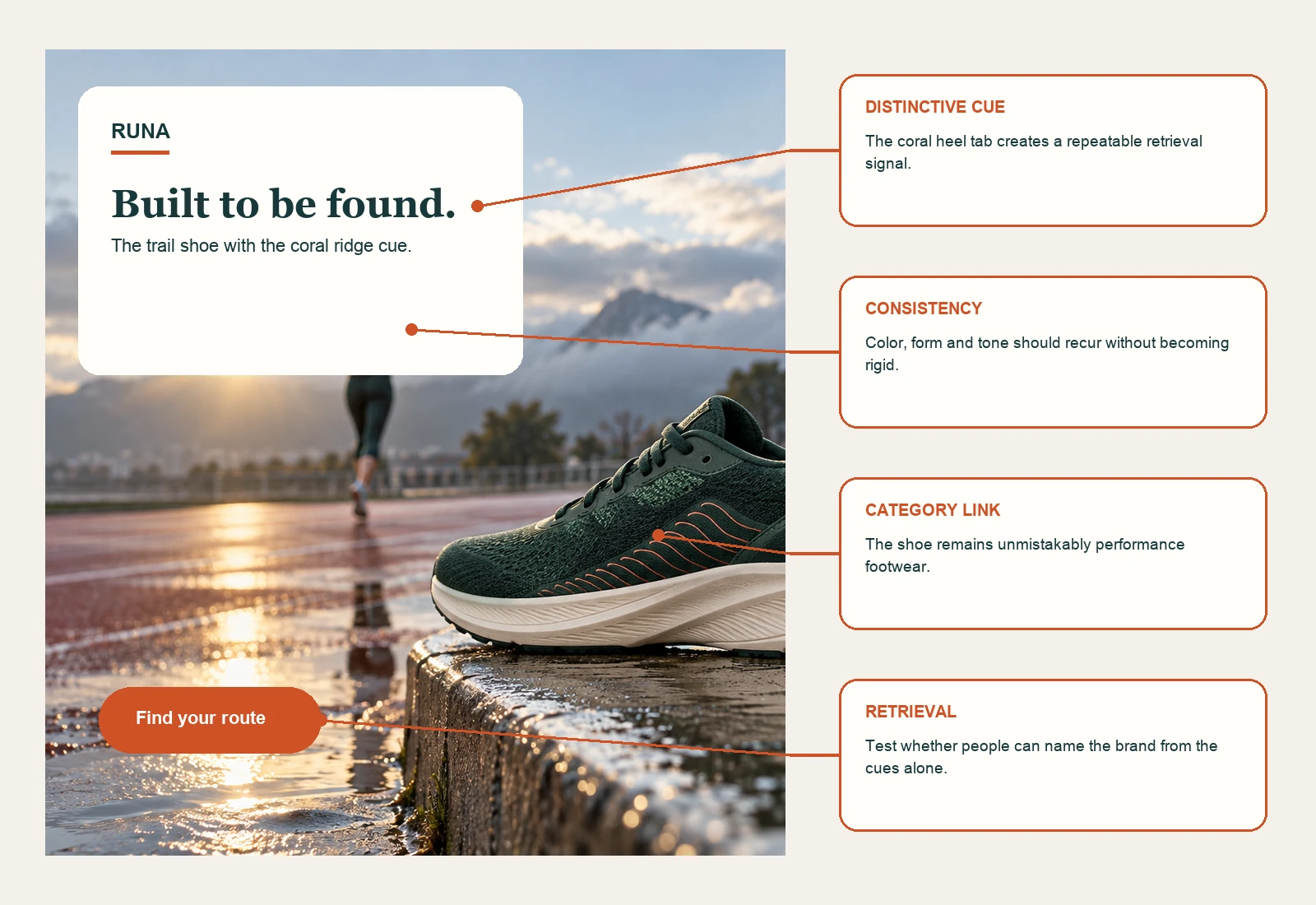
Identity cues
The R mark, coral line and evergreen field appear together. The combination is more diagnostic than any element alone. The name remains visible because this is still a growing brand and unaided attribution cannot be assumed.
Category and product evidence
The shoe is shown at a scale that exposes the sole geometry and material detail. The word "running" appears in supporting copy. The execution does not rely on an abstract motion image to communicate the category.
Audience fit
The message avoids elite language and frames progress as continuity. That supports the intended audience of committed recreational runners. It would be less suitable for a race-day product whose value rests on speed and competition.
Association building
"Find your next mile" links the brand with attainable forward movement. Repetition across onboarding, training content and packaging would determine whether this becomes a retrieval cue rather than a one-off campaign line.
How to test brand alignment and memory
Brand measurement is strongest when it separates exposure, attention, attribution, association and retrieval. A single "on brand" rating collapses those mechanisms and can hide important failure modes.
- Unaided attribution: show the execution without the name and ask which brand it is for. This tests whether non-name assets identify the source.
- Aided recognition: present brand options and measure correct recognition and competitor confusion.
- Cue ownership: test individual colors, shapes, sounds or phrases. Record correct attribution, uncertainty and misattribution.
- Association transfer: ask what the execution implies about the brand, then compare the response with the intended positioning.
- Category-entry retrieval: use realistic buying situations as prompts and measure whether the brand comes to mind.
- Delayed memory: repeat attribution and association measures after a delay. Immediate fluency can disappear quickly.
- Behavioral recognition: in shelf, feed or search simulations, measure whether brand cues improve finding and choice under realistic competition.
What neuromarketing can add
Eye tracking can show whether brand cues are viewed and when they are viewed relative to product and message. EEG and physiological measures may contribute evidence about attention or arousal, but they cannot prove brand meaning. Implicit association tasks can estimate the relative strength of associations, yet their interpretation depends on stimulus selection, reliability and context.
These methods are most useful when attached to a clear hypothesis. If the concern is source confusion, test attribution. If the concern is whether brand evidence arrives too late, analyze viewing sequence. If the concern is whether a new visual system changes perceived character, combine explicit association measures with behavior and qualitative explanation.
A research-informed brand review
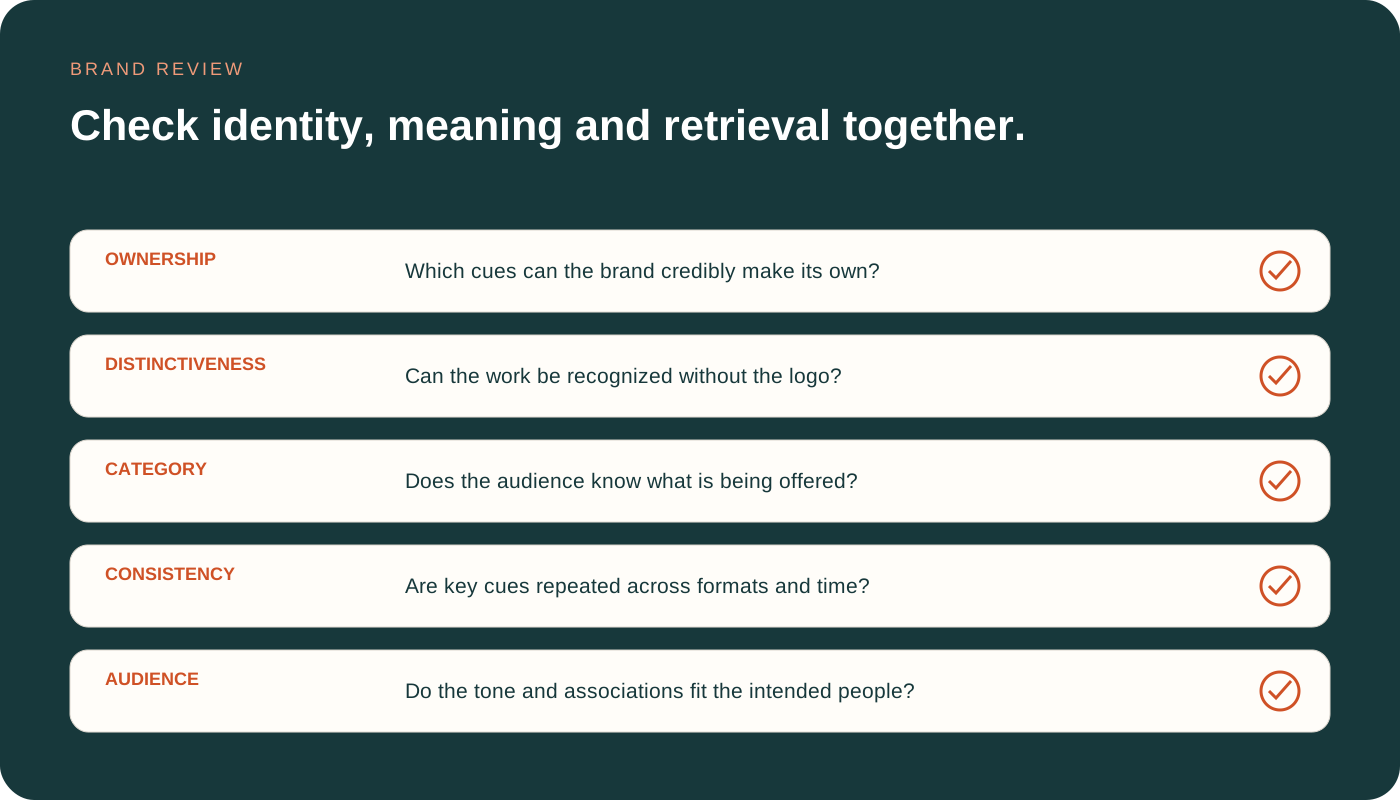
- Define the future retrieval cue. In which buying situation should this work make the brand easier to remember?
- Inventory the brand evidence. Identify name, logo, color, shape, product, verbal and behavioral cues.
- Check attribution. Determine whether the cues are owned, known and resistant to competitor confusion.
- Check meaning. Ask which associations the execution rehearses and whether the product credibly supports them.
- Check audience interpretation. Evaluate knowledge, cultural meaning, category familiarity and demographic relevance without relying on stereotypes.
- Review the moment of binding. Make sure the brand is present when the promise, product evidence and emotional response are encoded.
- Separate fixed and flexible rules. Protect diagnostic cues while allowing the layout to adapt to format, distance and context.
- Measure after a delay. Test brand retrieval and association when the full execution is no longer in view.
Common questions about brand alignment
Is a prominent logo enough?
No. Logo prominence can improve visibility, but effectiveness depends on attention, attribution, integration and the meaning attached to it. A visible mark cannot rescue an irrelevant or contradictory message.
Should every execution use the same layout?
No. Repeating distinctive cues can strengthen memory while composition adapts to context. The test is whether the audience still recognizes the source and receives compatible meaning.
Can a new campaign introduce new brand assets?
Yes, but new cues require learning. Pair them with established identifiers, repeat them consistently and test whether people attribute them correctly before treating them as owned assets.
Does unusual design always improve distinctiveness?
No. Novelty can attract attention without building brand memory. The unusual element must become associated with the advertiser and remain useful across exposures.
Can AI check brand guidelines?
AI can compare an asset with supplied rules, detect missing or altered identity elements and assess likely tone or audience fit. It cannot establish public ownership of a cue or actual audience interpretation without benchmark and research data.
The strategic value of brand analysis
Brand analysis turns guidelines into a theory of memory. It identifies which cues should be noticed, which associations they should activate and which buying situations should retrieve the brand. That makes creative review more useful than a compliance check.
The goal is not to make every execution look identical. It is to make every exposure contribute to the same recognizable, relevant structure in memory. A strong brand system gives creative teams a shared source of identity and enough flexibility to make the work fit the moment.
Research referenced
- Keller, K. L. (1993). Conceptualizing, measuring, and managing customer-based brand equity. Journal of Marketing, 57(1), 1-22.
- Romaniuk, J., and Sharp, B. (2004). Conceptualizing and measuring brand salience. Marketing Theory, 4(4), 327-342.
- Henderson, P. W., and Cote, J. A. (1998). Guidelines for selecting or modifying logos. Journal of Marketing, 62(2), 14-30.
- Jiang, Y., Gorn, G. J., Galli, M., and Chattopadhyay, A. (2016). Does your company have the right logo? How and why circular- and angular-logo shapes influence brand attribute judgments. Journal of Consumer Research, 42(5), 709-726.
- Keller, K. L. (1987). Memory factors in advertising: The effect of advertising retrieval cues on brand evaluations. Journal of Consumer Research, 14(3), 316-333.
- Wedel, M., and Pieters, R. (2000). Eye fixations on advertisements and memory for brands. Marketing Science, 19(4), 297-312.
- Pieters, R., Warlop, L., and Wedel, M. (2002). Breaking through the clutter: Benefits of advertisement originality and familiarity for brand attention and memory. Management Science, 48(6), 765-781.
- Romaniuk, J., and Nenycz-Thiel, M. (2014). Measuring the strength of color brand-name links: The comparative efficacy of measurement approaches. Journal of Advertising Research, 54(3), 313-319.