Message in advertising: how the brain turns creative into meaning and memory
An advertising message is not the sentence the team approves. It is the meaning an audience constructs from words, images, source cues and context, then carries into memory with some connection to the brand. Message analysis asks whether that chain survives exposure, comprehension, encoding and later retrieval.
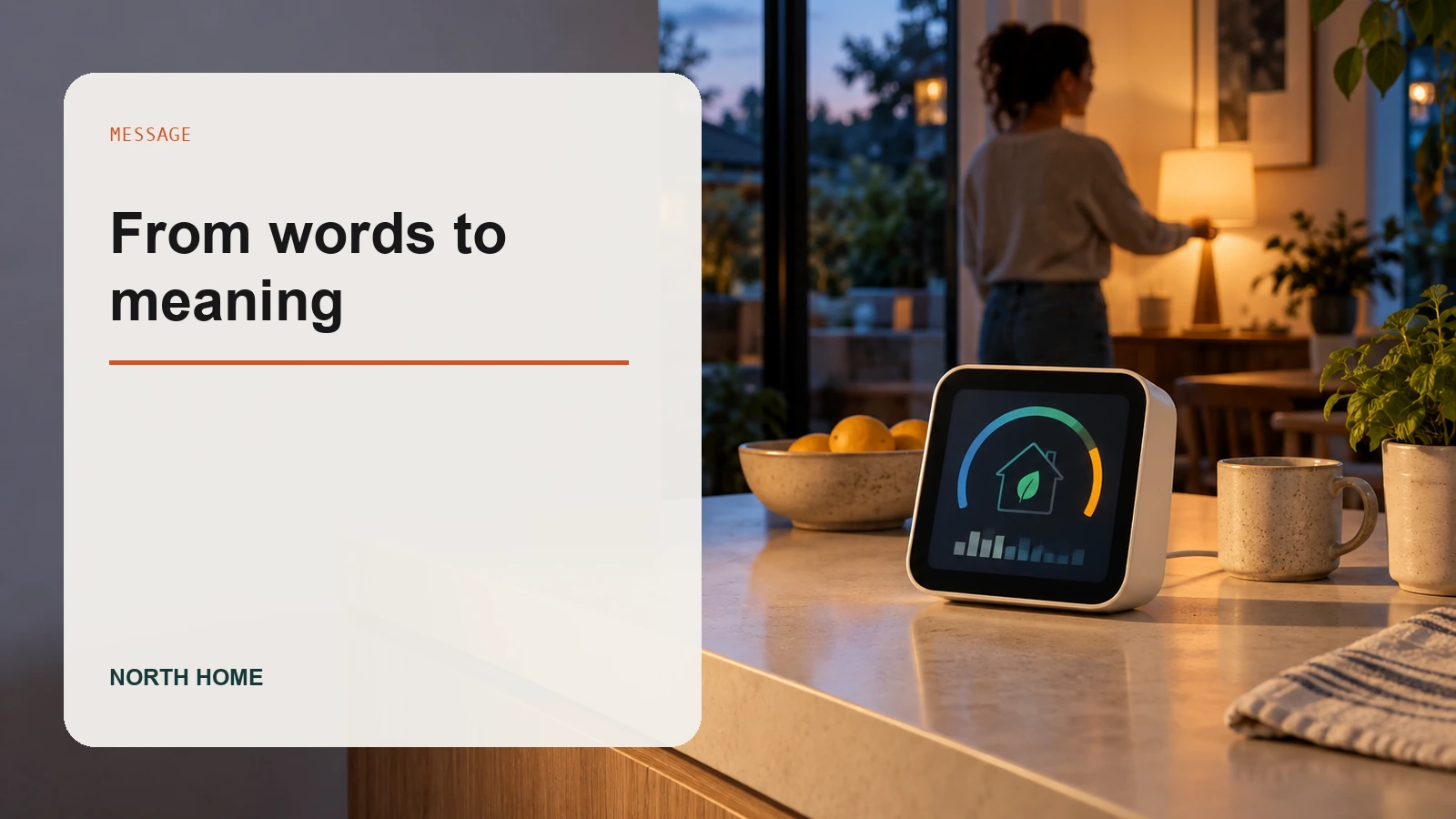
A home energy ad says, "A smarter way to live." The photograph shows a calm kitchen. A small device displays a colored dial. The line sounds polished, but what has actually been communicated? The product might be a thermostat, an electricity plan, a security system or an appliance. The viewer can appreciate the tone without forming the proposition.
That distinction matters. Copy can be fluent and still underspecify the offer. A claim can be understood and still fail to attach to the advertiser. A memorable phrase can leave behind no usable reason to choose. The message domain therefore sits between readability and persuasion: first the audience must construct the intended meaning; then that meaning must be available when a relevant decision occurs.
The audience constructs the message
Communication is not a transfer of a finished object from advertiser to viewer. The creative supplies cues. The viewer combines those cues with category knowledge, current goals, cultural conventions and the surrounding environment. Meaning emerges from that interaction.
Consider "Take back your evening." In a meal-kit ad, the line may imply time saved from planning and shopping. In a home-security ad, it may imply safety. In an energy ad, it may imply automated control. The photograph, product form, logo, proof and placement determine which interpretation becomes plausible.
This is why message review cannot isolate the headline. An image can specify a vague line, contradict a precise one or redirect it toward a different benefit. A button can complete the proposition or open a new one. Even typography contributes: a warning-like treatment can change the implied force of otherwise neutral words.
Four transformations stand between copy and memory
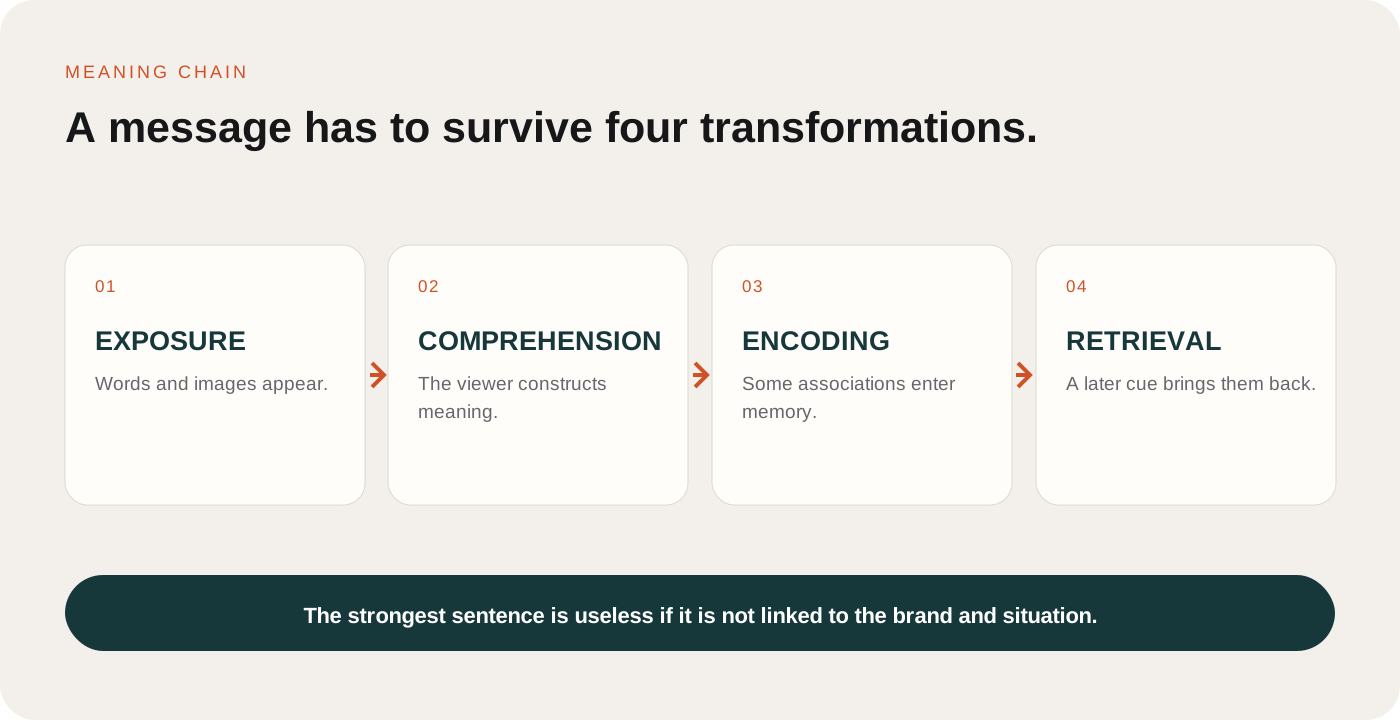
1. Exposure
The relevant verbal and visual information must enter view with enough sensory quality and time to be processed. This is not guaranteed. A video line may arrive while the viewer is looking away. A mobile headline may be truncated. A package claim may be below the shelf line.
2. Comprehension
The viewer must resolve what is being offered, for whom, under what conditions and with what consequence. Comprehension can fail because of language, missing category cues, unfamiliar abbreviations, dense syntax or a mismatch between picture and copy.
Ratneshwar's experiments on product descriptions showed that comprehensibility changed how people used source expertise. When comprehension was low, participants relied more on the inventor's expertise. When comprehension was higher, they could process the product information more systematically. The broader lesson is not that expertise cues are bad. It is that the basis of persuasion changes when the message itself cannot be processed.
"Comprehensibility moderated the persuasive impact of source expertise."
S. Ratneshwar, Comprehension's Role in Persuasion, 1991
3. Encoding
Some aspect of the message must produce a memory trace. Craik and Lockhart's levels-of-processing framework proposed that retention depends on the operations performed during encoding, with semantic processing generally producing more durable memory than attention to surface features alone. Advertising should not translate this into "make people think hard." It should ask whether the execution gives the audience a meaningful relation to encode.
"Live energy detail" becomes more memorable when it resolves a current uncertainty: why was last month's bill high? A statistic becomes more useful when it supports a claim the audience already understands. Repetition of an unconnected slogan may strengthen familiarity while leaving the proposition weak.
4. Retrieval
Advertising memory is valuable when a later cue can access it. Kevin Lane Keller's research on retrieval cues showed that verbal or visual information from an ad could facilitate access to the ad memory trace and affect brand evaluations. Competitive advertising also created interference. The implication is practical: a message should build routes that a buying situation can later activate.
A home energy brand might link itself to "seeing where the energy goes." At the moment a bill arrives, that problem can cue the brand. A generic promise such as "Live smarter" supplies fewer distinctive retrieval routes unless execution and repetition give it specific ownership.
The brain can extract gist quickly, but gist is not the full claim
Pieters and Wedel studied what typical ads communicate within a single fixation. At 100 milliseconds, people could identify that they were seeing an ad and identify product and brand above chance, especially when the ad used category-typical structure. The finding is valuable and easy to overstate.
"Even after an extremely coarse visual presentation of 100 milliseconds, the product and brand ... are identified well above chance levels."
Rik Pieters and Michel Wedel, Ad Gist, 2012
Rapid gist does not mean a complex benefit, condition or comparison is understood in 100 milliseconds. It means the visual system can classify scenes and familiar structures with remarkable speed. Creative should use that early classification to establish category and source, then allow the proposition to unfold at a pace the format supports.
Framing changes which interpretation becomes available
Gain and loss frames describe consequences from different reference points: gain the benefit, or avoid the cost of missing it. Research does not support a universal winner. Baba Shiv, Julie Edell and John Payne found that the relative impact of positive and negative claim framing depended on processing before choice and on whether people focused on the claim or on the tactic used to present it.
The strategic question is fit. Does the frame match the category, audience state, evidence and requested behavior? "Stop wasting energy" may create urgency, but it may also imply blame. "See where your energy goes" emphasizes control and diagnosis. Either can work in some conditions. The creative review should articulate the hypothesized mechanism instead of treating negative language as inherently stronger.
Concrete language and diagnostic evidence
Specificity helps when it reduces interpretive spread. "See appliance-level energy use" tells the viewer more than "unlock intelligent living." But specificity also raises an evidence obligation. A precise number, comparison or superlative should be substantiated and qualified in a way that preserves the intended understanding.
Proof works best when the relationship is visible. A saving claim beside the condition that produces the saving is easier to evaluate than a claim at the top and a caveat at the bottom. This is both a hierarchy issue and a message issue: the audience should not have to discover which evidence belongs to which promise.
The action is part of the proposition
"Buy now" is not a neutral ending. It asks the audience to accept a decision state. "See your usage" asks for diagnosis. "Check your home" asks for eligibility. The call to action should continue the logic of the message and match the audience's likely readiness.
A worked example: NORTH HOME
The fictional NORTH HOME service includes a small display and an app that show live household energy use. An early line, "A smarter way to live," establishes tone but not a diagnostic proposition. The revised message begins with a job the audience can understand: "See what your home uses." The supporting line names the product value: live detail and clear ways to reduce use.
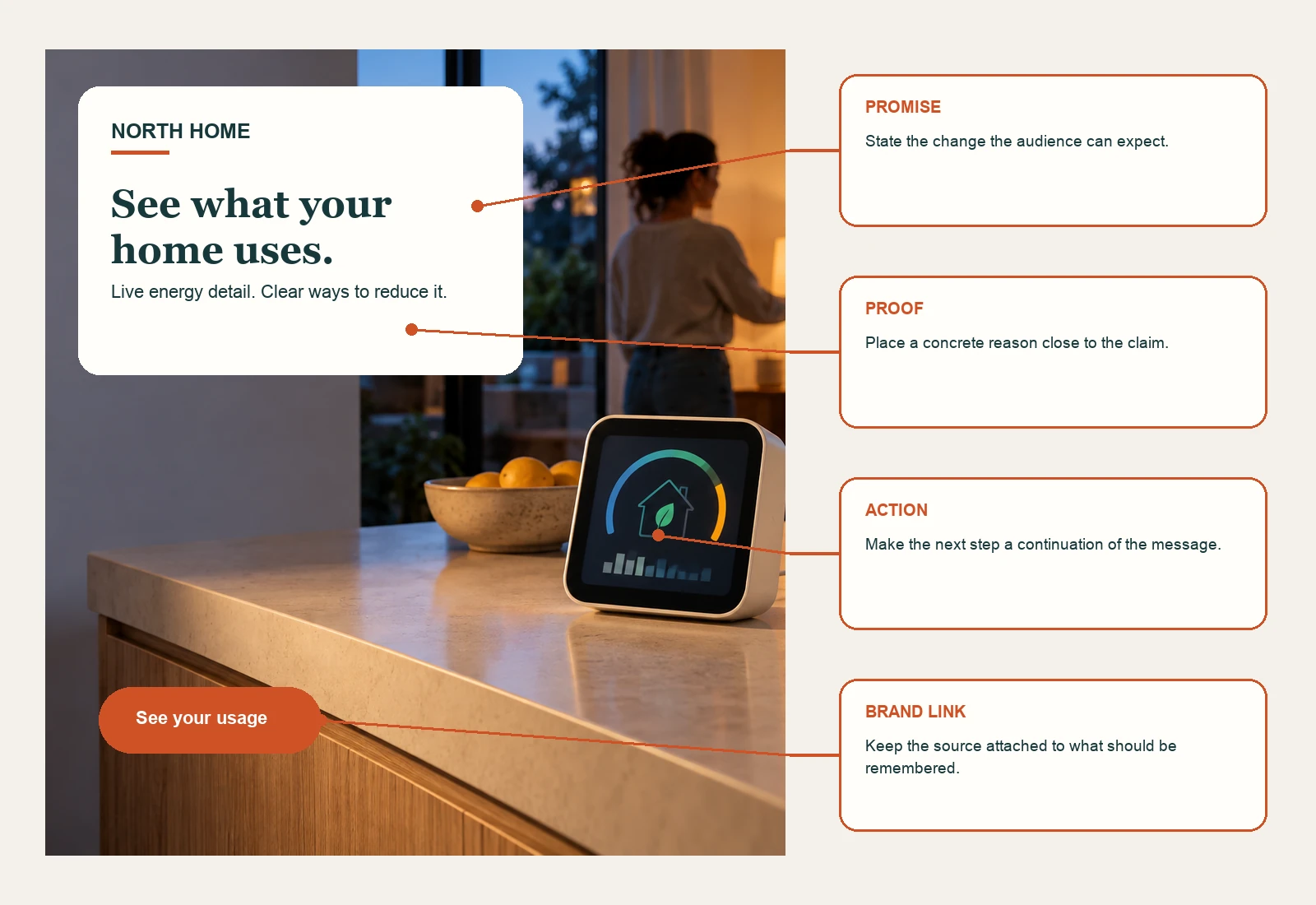
Promise
The promise names visibility, not an abstract intelligence benefit. It creates a question the product can answer.
Proof
The display and "live energy detail" support the promise. A live product demonstration or interface frame could strengthen this further, provided it represents the service accurately.
Action
"See your usage" continues the same idea. It does not force a purchase before the viewer understands whether the service fits.
Brand link
NORTH HOME remains close to the proposition. If the brand were visible only at the end of a video, the story might be remembered without its source.
Test interpretation, memory and source separately
Message testing is often reduced to liking or headline preference. Those measures can be useful, but they do not establish what meaning was constructed.
- Open interpretation: after realistic exposure, ask "What was this ad saying?" Code the answers before showing response options.
- Claim comprehension: ask targeted questions about the benefit, evidence and conditions. Include plausible wrong interpretations.
- Brand linkage: test which advertiser delivered the message. Recognition with a supplied list is easier than unaided recall and should be reported separately.
- Delayed retrieval: return after a delay and use a buying-situation cue, not only the ad image. Does the intended brand or proposition come to mind?
- Action understanding: ask what the person expects after clicking. A button can receive clicks while setting the wrong expectation.
- Competitive interference: place the ad among category alternatives. A distinctive line in isolation may become generic in a real feed.
Recall and recognition are not interchangeable. Bagozzi and Silk's study of print ads found that the two measures did not by themselves represent one underlying memory state. A message can be recognized when shown and still fail to come to mind unaided. Choose the measure that reflects the intended business situation.
A research-informed message review
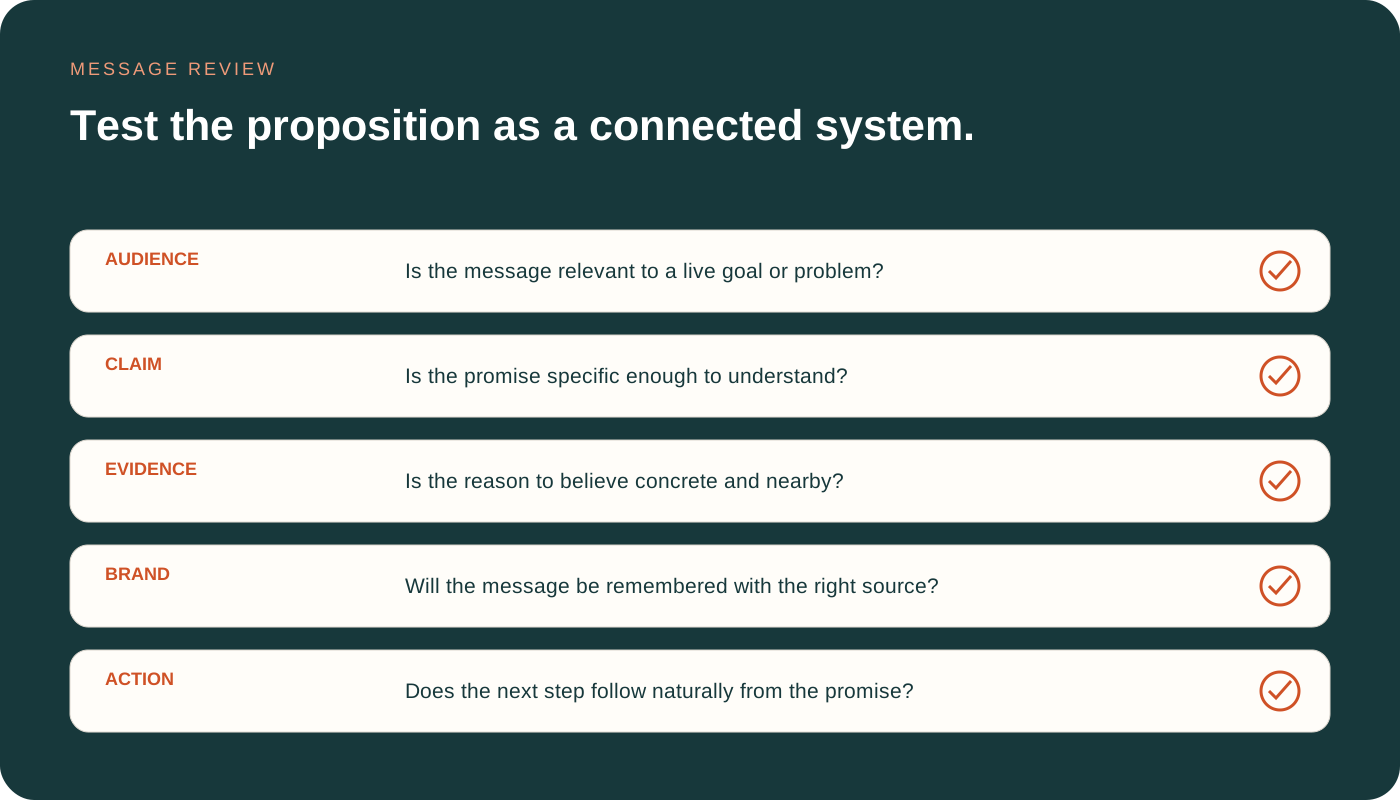
- State the audience problem. What live goal, uncertainty or tension makes the message relevant?
- Write the proposition without the headline. If the team needs a paragraph to explain it, the execution may be carrying unresolved strategy.
- Map every element to a role. Mark promise, evidence, qualification, source and action. Elements with no role need a reason to remain.
- Check semantic agreement. The image, headline, proof and button should narrow interpretation in the same direction.
- Identify the retrieval cue. What future situation should bring the brand and message to mind?
- Test competitors. Replace the logo mentally. If every competitor could say the same thing in the same way, the message may lack ownership.
Common questions about advertising messages
Should an ad communicate one message?
One primary proposition is a useful discipline for brief exposures. Supporting evidence and qualifications can coexist when their roles are clear. The problem is not multiple sentences; it is multiple unresolved priorities.
Is a shorter headline always clearer?
No. Short copy can be ambiguous. A slightly longer line may reduce inference by naming the product, audience or consequence.
Do emotional images weaken rational messages?
Not inherently. An image can make a consequence concrete or create relevance. It weakens the message when it implies a different promise or consumes attention without supporting meaning.
Should the brand name appear in the headline?
Sometimes. The requirement is source linkage, not a fixed placement. Product form, distinctive assets, voice and logo can all contribute, but the link should be tested rather than assumed.
Can an AI model judge message clarity?
It can identify ambiguity, competing claims and missing evidence. Human testing remains valuable because interpretation depends on audience knowledge, language, culture and context.
The strategic value of message analysis
Strong copy is not merely concise or memorable. It gives the intended audience enough material to build the right meaning, connects that meaning to credible evidence and leaves a route back to the brand when the relevant situation occurs.
A message review makes those dependencies explicit. It catches the elegant line that hides the category, the persuasive claim that lacks proof, the useful benefit that belongs to no brand and the call to action that jumps beyond the audience's readiness. These are not matters of tone alone. They are failures in the communication chain.
Research referenced
- Pieters, R., and Wedel, M. (2012). Ad gist: Ad communication in a single eye fixation. Marketing Science, 31(1), 59-73.
- Ratneshwar, S. (1991). Comprehension's role in persuasion. Journal of Consumer Research, 18(1), 52-62.
- Craik, F. I. M., and Lockhart, R. S. (1972). Levels of processing: A framework for memory research. Journal of Verbal Learning and Verbal Behavior, 11(6), 671-684.
- Keller, K. L. (1987). Memory factors in advertising: The effect of advertising retrieval cues on brand evaluations. Journal of Consumer Research, 14(3), 316-333.
- Keller, K. L. (1991). Memory and evaluation effects in competitive advertising environments. Journal of Consumer Research, 17(4), 463-476.
- Shiv, B., Edell, J. A., and Payne, J. W. (1997). Factors affecting the impact of negatively and positively framed ad messages. Journal of Consumer Research, 24(3), 285-294.
- Bagozzi, R. P., and Silk, A. J. (1983). Recall, recognition, and the measurement of memory for print advertisements. Marketing Science, 2(2), 95-134.
- Chessa, A. G., and Murre, J. M. J. (2007). A neurocognitive model of advertisement content and brand name recall. Marketing Science, 26(1), 130-141.