Emotion in advertising: how feeling shapes attention, memory and choice
Emotion in advertising is not a switch between rational and emotional creative. Feelings influence what receives priority, how events are appraised, what enters memory and which judgments seem appropriate. The useful question is not whether an ad is emotional, but which emotion it evokes, why that emotion fits and how it remains connected to the brand.
A family gathers around dinner and laughs at a story. The scene is warm, familiar and easy to like. A meal brand appears at the end. Many teams would call the execution "emotional" and stop the diagnosis there. But warmth, amusement, nostalgia, relief and belonging are not interchangeable. They imply different appraisals and can shape memory and choice through different routes.
Emotion analysis makes the mechanism explicit. What event is the viewer being invited to appraise? What goal or value does it touch? How intense is the response? Does the product cause, enable or merely sponsor the moment? And when the feeling remains, does the advertiser remain with it?
Emotion is more than positive or negative feeling
Emotion involves changes across several systems: appraisal of a situation, subjective feeling, physiological response, expression and readiness to act. Researchers disagree about the precise architecture, but there is broad agreement that a smile or a high arousal signal is not the whole emotion.
Advertising practice often compresses this complexity into valence and arousal. Valence asks whether the state is pleasant or unpleasant. Arousal asks how activated it is. Those dimensions are useful, but two emotions with similar valence can produce different judgments. Anger and fear are both negative and often high in arousal; anger is associated with greater certainty and approach, while fear is associated with uncertainty and avoidance.
Jennifer Lerner and colleagues reviewed decades of evidence showing that emotion effects are "potent, pervasive, predictable" but can be beneficial or harmful depending on the choice and context. Their appraisal-tendency account is especially relevant to creative strategy because it asks which pattern of meaning the emotion carries into later judgment.
"Emotions constitute potent, pervasive, predictable, sometimes harmful and sometimes beneficial drivers of decision making."
Jennifer Lerner, Ye Li, Piercarlo Valdesolo and Karim Kassam, Emotion and Decision Making, 2015

Appraisal gives emotion its direction
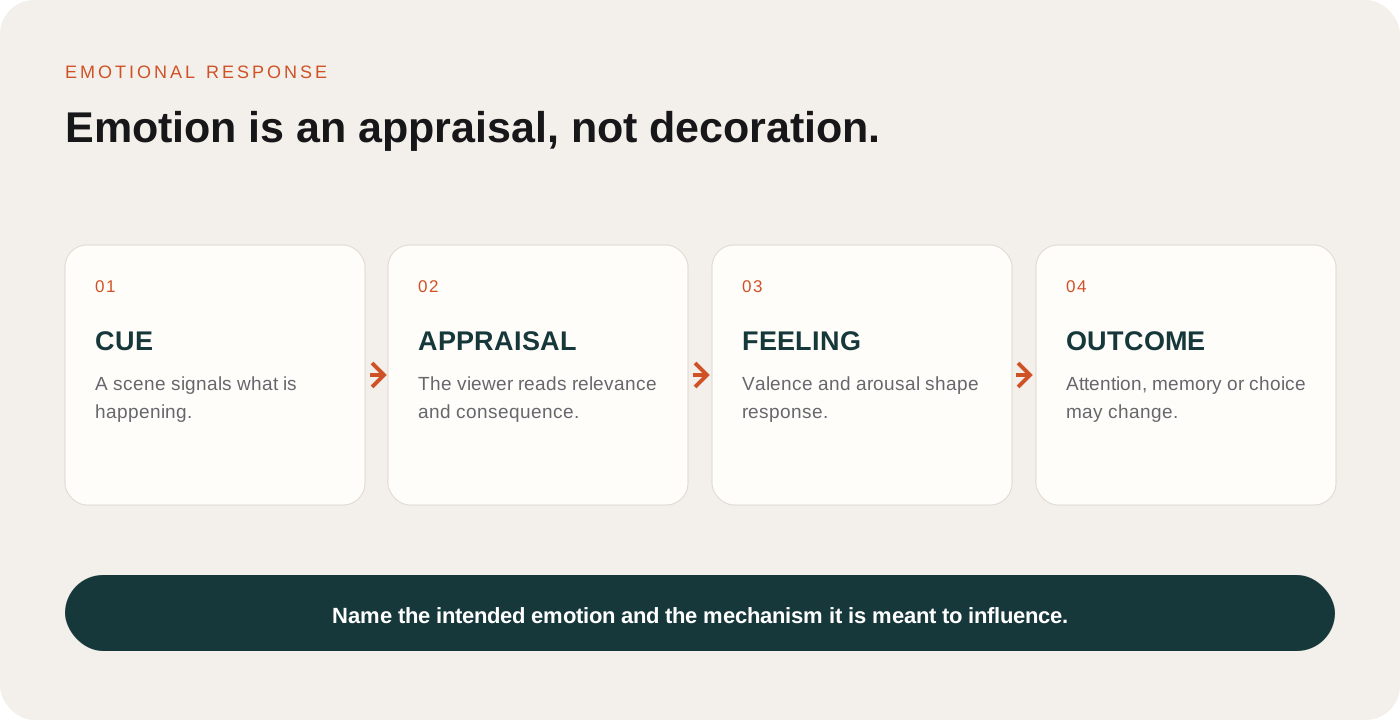
Appraisal theories propose that emotions arise from evaluations of events in relation to concerns: Is this relevant to me? Does it help or threaten a goal? Who caused it? Can I cope? Is the outcome certain? Different patterns produce different emotional states.
For advertising, appraisal is a better briefing language than "make it emotional." A retirement service might aim for relief by showing control returning after uncertainty. A sports brand might aim for earned pride by showing effort followed by mastery. A road-safety campaign might use anticipatory concern, but fear without a credible coping action can produce avoidance or defensive processing.
Integral and incidental emotion
Integral emotion is tied to the decision itself: concern about energy cost while choosing a tariff, or joy anticipated from a family trip. Incidental emotion comes from another source and can carry into the judgment. Music, program context, weather and a previous story can all influence the state in which an ad is processed.
This distinction matters because a favorable response to the ad can be real while the product mechanism remains weak. A beautiful reunion scene may create warmth, but if the brand has no credible role in enabling the reunion, the feeling may attach to the story rather than the advertiser.
Emotional fit is not the same as category convention
Category conventions provide learned expectations, not rules. Insurance often uses reassurance, sports uses achievement and food uses pleasure or belonging. A brand can depart from those patterns, but the execution must give the audience enough information to understand why the emotion belongs.
Fit also depends on audience and moment. Humor about travel disruption may feel relieving to frequent travelers after the problem is solved and dismissive while they are stranded. Nostalgia can strengthen continuity for an established brand and feel manufactured for a new one. Cultural knowledge changes the meaning of gestures, family roles, music and humor.
Arousal changes what memory prioritizes
Emotional arousal can strengthen memory for high-priority information, but it does not enhance every detail equally. Mather and Sutherland's arousal-biased competition model proposes that arousal amplifies competition: high-priority information receives a larger advantage, while lower-priority information can be suppressed.
This has a direct creative implication. If the most emotionally intense moment gives priority to the character, spectacle or social issue while the brand is peripheral, arousal may strengthen the wrong trace. Brand presence should not interrupt the experience, but it should be integrated into the causal structure or perceptual priority of the moment.
Emotional memory also changes over time. Central details can remain while contextual details fade. A viewer may remember that an ad was moving but misattribute the advertiser. Delayed brand linkage is therefore a separate test from immediate emotional response.
Attention is not proof of the intended emotion
A face, sudden sound or threat cue can capture attention. That tells us little about whether the response is empathy, confusion, surprise or discomfort. Longer viewing can reflect interest, difficulty or concern. Emotional diagnosis requires converging evidence from self-report, behavior and, where appropriate, physiological measures.
Feelings influence judgment through several routes
Holbrook and Batra treated emotional reactions as mediators between ad content and attitudes toward the ad or brand. The language is important: emotion can be part of the process, not merely an output score at the end of a test.
One route is evaluative. The experience of the ad contributes to attitude toward the ad, which can influence brand response. Another route is informational: people may use how they feel as evidence, especially when they attribute the feeling to the object being judged. A third route is motivational: discrete emotions can alter risk perception, information search and action tendency.
Lau-Gesk and Meyers-Levy showed that emotional persuasion depends on more than valence. When processing motivation was low, positive emotional ads produced more favorable attitudes than negative ones. When motivation was high, attitudes depended on whether allocated processing resources matched the demands of the emotion. An emotional execution can therefore ask too much, even when its intended feeling is strategically appropriate.
"Properties of emotions other than valence influence consumers' responses to emotional ads."
Loraine Lau-Gesk and Joan Meyers-Levy, Emotional Persuasion, 2009
A worked example: EMBER and family dinner
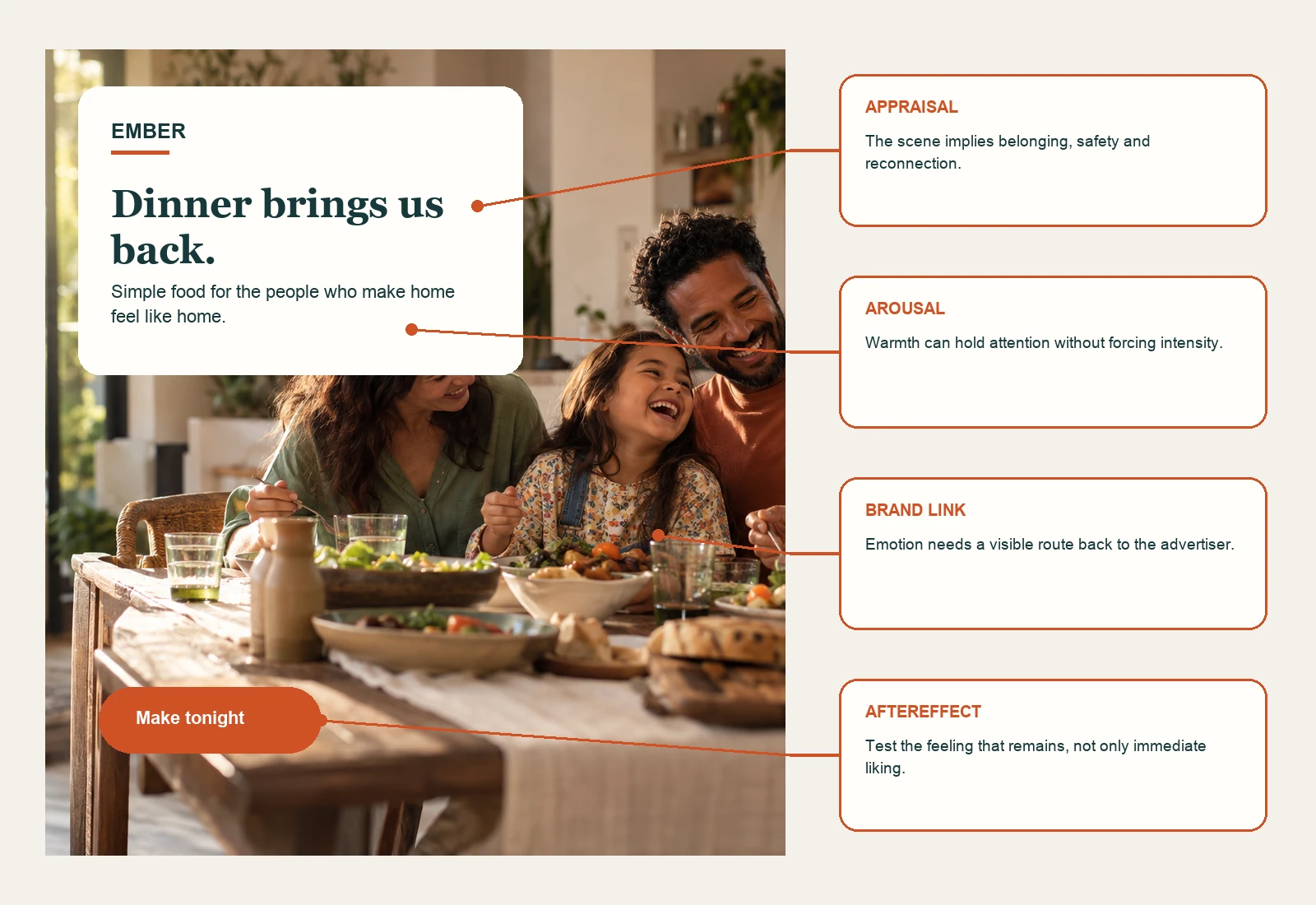
EMBER is a fictional prepared-meal service. The strategy is not simply convenience. It is to reduce the coordination that prevents families from sharing an ordinary meal. That gives the emotional scene a product role: the service removes friction so a valued ritual can happen more often.
Specify the appraisal
The child is not merely happy. The scene depicts being included and listened to across generations. The intended appraisal is that an ordinary dinner can restore connection after a fragmented day.
Control intensity
The execution uses warmth and laughter rather than a dramatic reunion. That lower intensity fits a repeat-purchase meal service and avoids promising that a product will solve family relationships.
Give the brand a causal role
The supporting copy explains the role: simple food makes the gathering easier to start. The brand enables the occasion without claiming ownership of the emotion itself.
Plan the aftereffect
The intended residue is not only "that was a nice family." It is "EMBER helps make an ordinary shared dinner easier." Delayed testing should separate those two memories.
What neuromarketing measures can and cannot establish
Emotion is a common area for overclaiming. Facial coding, skin conductance, heart rate, pupil size and EEG can all contribute evidence, but none uniquely identifies a complex emotion on its own.
- Facial behavior: visible expressions can be coded, but people regulate expression and similar movements can have different meanings.
- Skin conductance: indicates sympathetic arousal, not whether the state is positive, negative, relevant or brand-linked.
- Heart rate: changes with orienting, effort, arousal and movement. Interpretation depends on timing and protocol.
- EEG: can provide temporal information about neural activity. Simple labels such as "engagement" or "desire" often compress contested inferences.
- Self-report: gives access to conscious feeling and appraisal but is influenced by language, memory and demand characteristics.
- Behavior: viewing, sharing, choice or avoidance shows consequences, but each behavior has several possible causes.
A strong study triangulates. If self-report indicates tenderness, skin conductance shows moderate arousal, open responses describe family connection and delayed testing retains the brand role, the interpretation is stronger than any single dashboard score.
A research-informed emotion review
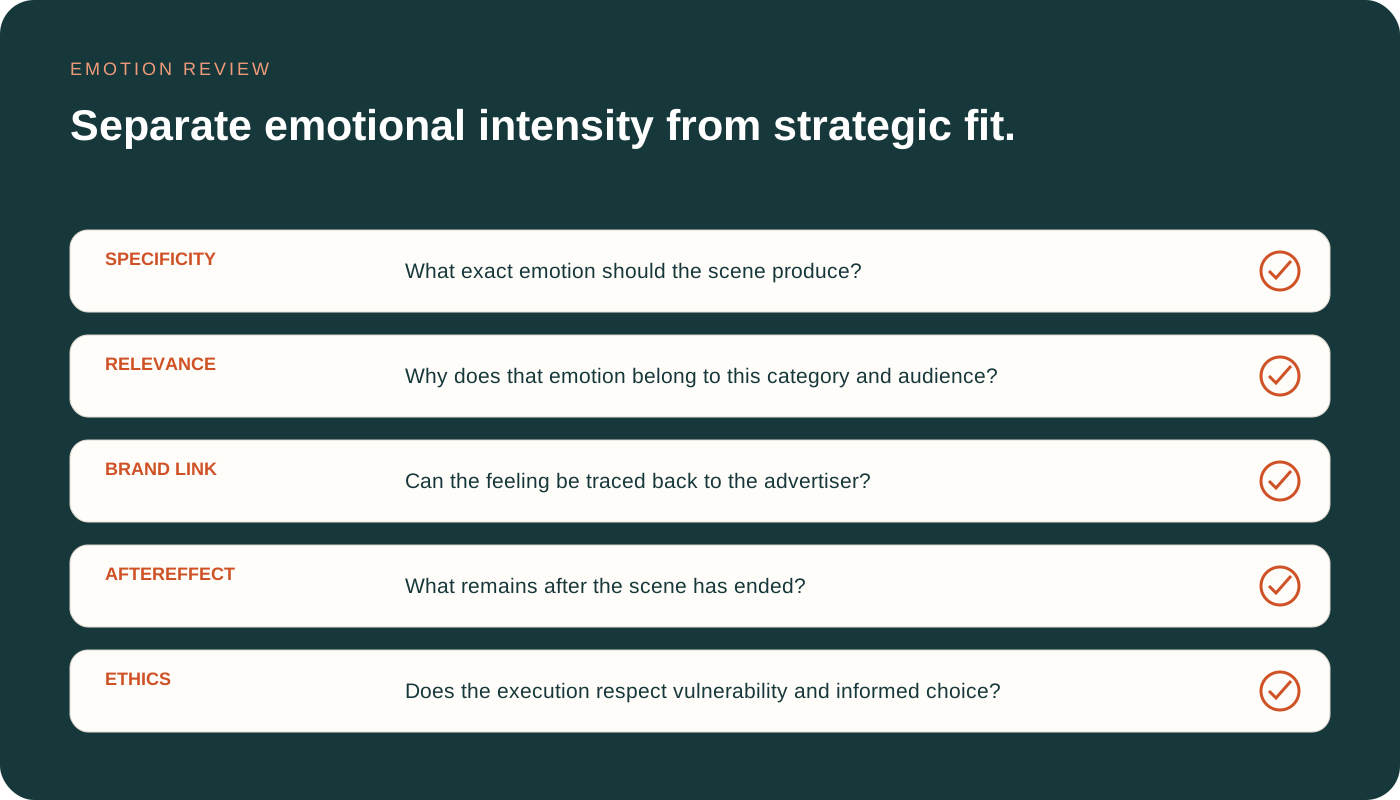
- Name the discrete emotion. Replace "positive" with relief, pride, amusement, tenderness, hope or another defensible state.
- Write the appraisal. What does the viewer infer about goals, agency, certainty, control and consequence?
- Explain the product role. Does the product cause, enable, symbolize or merely accompany the emotional event?
- Check priority at peak moments. What is visually and narratively dominant when arousal is highest?
- Test immediate and delayed effects. Measure the feeling, the brand link and the intended association after time has passed.
- Review ethics and vulnerability. Fear, shame, grief and social exclusion require particular care, especially for sensitive audiences and high-stakes categories.
Common questions about emotion in advertising
Do emotional ads work better than rational ads?
The categories are too broad. Most effective advertising combines information and feeling. The result depends on the emotion, product role, audience, objective, evidence and context.
Is positive emotion safer?
Positive valence can support liking, but it can also become generic or detach from the brand. Negative emotions can motivate or inform in some settings and cause avoidance in others.
Does high arousal improve memory?
It can prioritize central information, but lower-priority details may suffer. The critical question is what has priority during arousal and whether the brand is part of that information.
Do faces guarantee empathy?
No. Faces attract attention and communicate social information, but empathy depends on appraisal, identification, narrative and context.
Can AI infer emotion from an ad?
AI can analyze cues and propose likely appraisals. It cannot establish how a specific audience actually feels without audience evidence, and facial-expression inference should be treated with care.
The strategic value of emotion analysis
Emotion should be briefed as a mechanism. The team names the intended state, identifies the appraisal that produces it, explains its relevance to the product and decides what outcome it should influence. That creates a testable theory rather than an instruction to "make people feel something."
It also protects the brand from emotional borrowing. The most moving scene in the world is weak advertising if the audience remembers the feeling, forgets the source or rejects the brand's claim to the moment. Emotional power and brand effectiveness are related only when the creative builds the bridge.
Research referenced
- Lerner, J. S., Li, Y., Valdesolo, P., and Kassam, K. S. (2015). Emotion and decision making. Annual Review of Psychology, 66, 799-823.
- Mather, M., and Sutherland, M. R. (2011). Arousal-biased competition in perception and memory. Perspectives on Psychological Science, 6(2), 114-133.
- Holbrook, M. B., and Batra, R. (1987). Assessing the role of emotions as mediators of consumer responses to advertising. Journal of Consumer Research, 14(3), 404-420.
- Edell, J. A., and Burke, M. C. (1987). The power of feelings in understanding advertising effects. Journal of Consumer Research, 14(3), 421-433.
- Lau-Gesk, L., and Meyers-Levy, J. (2009). Emotional persuasion. Journal of Consumer Research, 36(4), 585-599.
- Olney, T. J., Holbrook, M. B., and Batra, R. (1991). Consumer responses to advertising. Journal of Consumer Research, 17(4), 440-453.
- Hutter, M., and Sweldens, S. (2018). Dissociating controllable and uncontrollable effects of affective stimuli on attitudes and consumption. Journal of Consumer Research, 45(2), 320-349.
- Poels, K., and Dewitte, S. (2006). How to capture the heart? Reviewing 20 years of emotion measurement in advertising. Journal of Advertising Research, 46(1), 18-37.