Cognitive load in advertising: the science of making messages easier to process
Cognitive load in advertising is the mental work required to identify the advertiser, construct the proposition, compare the information and decide what to do. The issue is not simply whether a layout looks busy. It is whether the creative asks for more coordination, inference or memory than the viewing situation is likely to support.
A traveler sees an ad for a payment card while moving through an airport. The creative offers fee-free spending, live exchange rates, lounge access, instant card controls, travel insurance and points. Every benefit may be accurate. Together, they create a sequence of unanswered questions: Which promise is primary? Which features apply to me? Is this a bank account, a credit card or a membership? What should I do first?
That sequence is cognitive work. Some work is unavoidable because financial products are complex. Some is introduced by the execution: equal visual weight, duplicated messages, unfamiliar labels, separated evidence and several calls to action. A useful cognitive-load review distinguishes those two sources before it starts deleting content.
Cognitive load is not a synonym for visual clutter
Visual clutter can contribute to processing difficulty, but the terms are not interchangeable. A dense transit map can be visually complex and still support a well-defined task. A minimal financial ad can look calm while requiring the viewer to infer what the product is, who qualifies and what an unexplained claim means.
The relevant question is functional: what operations must a person perform to arrive at the intended understanding? In an ad, those operations can include locating the message, resolving pronouns, connecting a statistic to a claim, identifying the brand, comparing options and holding an earlier line in memory while reading a later qualification.
This is why a simple element count is weak evidence. Five mutually reinforcing elements may be easier to process than three contradictory ones. A product photograph, headline, proof point, brand and action can form one coherent unit. Two headlines that imply different benefits can create more work than that entire set.

Working memory is limited, but not a fixed seven-slot box
Working memory allows information to be held and manipulated over a short interval. Alan Baddeley's influential account describes interacting components for verbal and visuospatial material, coordinated by attentional control. The model has developed over time, but its practical implication remains useful: active processing capacity is limited, and simultaneous demands can interfere with one another.
Advertising often creates a split task. The viewer reads a headline while trying to identify a product from an image, remembers a price while checking a condition, or compares several benefits while locating the action. The creative can reduce this coordination cost by placing related evidence together, using familiar category cues and establishing a clear order.
"Working memory refers to a brain system that provides temporary storage and manipulation of information."
Alan Baddeley, Working Memory, Science, 1992
Capacity also depends on knowledge. An experienced media buyer can compress unfamiliar data into learned patterns that a novice must process item by item. A frequent traveler may understand "0% FX markup" immediately; another viewer may first need to decode the abbreviation and then infer its value. Expertise changes the size of the mental units, which is one reason audience knowledge belongs in a creative review.
What advertising can borrow from cognitive load theory
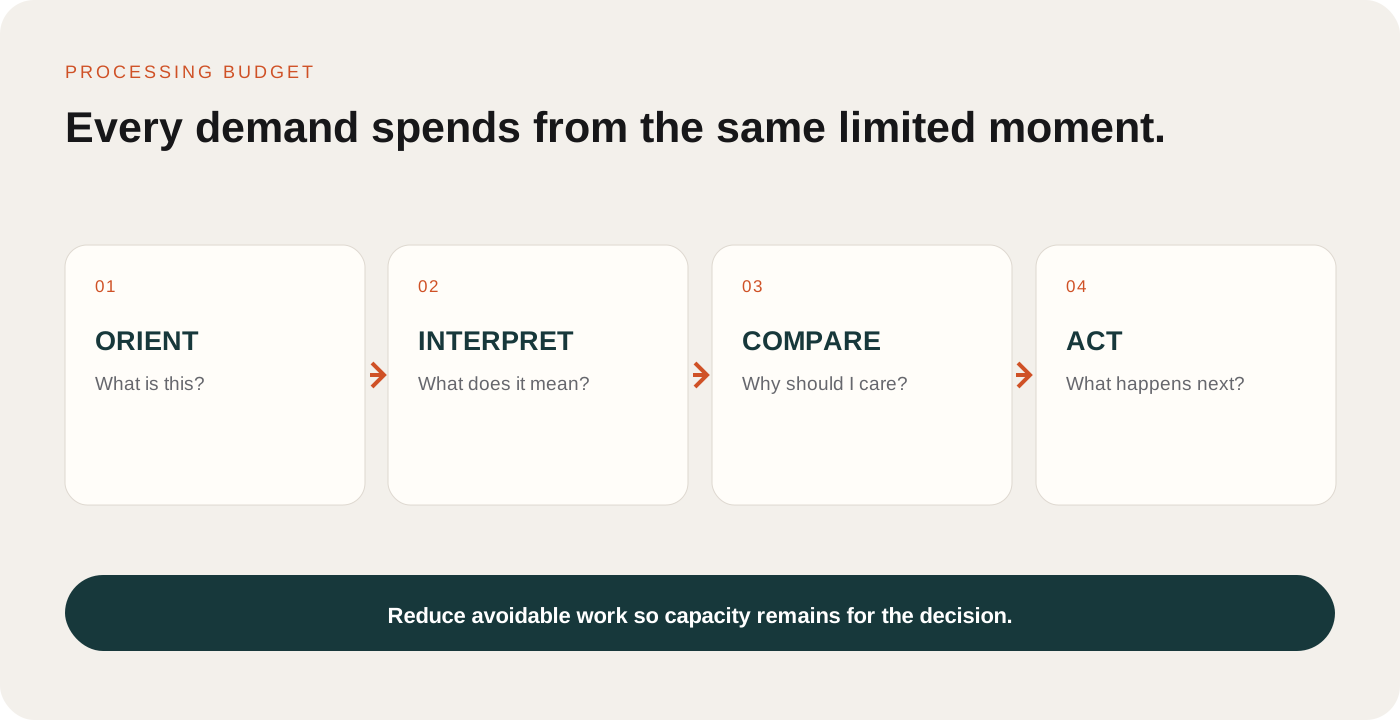
Cognitive load theory was developed in research on learning and problem solving, not as a general score for advertisements. John Sweller's early work examined how means-ends problem solving could consume processing capacity that might otherwise support schema acquisition. Later work distinguished demands inherent to the material from demands created by its presentation.
The distinction travels to advertising with care. A mortgage has real complexity. A safety warning may need detail. A business-to-business offer may require technical qualification. Those demands cannot be designed away without changing the substance. But the creative can add avoidable work by scattering conditions, using competing terminology or forcing the reader to reconcile the headline with an unrelated visual.
"Providing attribute information about alternatives can both help and hinder consumers evaluate products."
Kevin Lane Keller and Richard Staelin, Effects of Quality and Quantity of Information on Decision Effectiveness, 1987
Keller and Staelin separated information quality from information quantity. Their experiments supported a point that is easy to miss in creative review: more information can improve a decision when it is useful, yet additional quantity can also impair evaluation. The design task is not to pursue the lowest possible information count. It is to preserve the information that improves the decision and reduce the work that does not.
Intrinsic demand
This is the difficulty of the proposition itself for this audience: the number of interacting facts required for an accurate understanding. A regulated offer with thresholds and exclusions has higher intrinsic demand than a simple product launch. The ethical response is better sequencing and explanation, not hiding the conditions.
Extraneous demand
This is work caused by presentation rather than substance. Examples include a legend far from the chart it explains, several labels for the same feature, decorative numbers that resemble prices, or a button whose wording does not complete the promise.
Useful effort
Not all effort is a defect. Comparing two plans, imagining a product in use or resolving a well-constructed metaphor can deepen processing. The question is whether the effort advances the intended judgment. Difficulty that merely makes the viewer repair the layout is different from elaboration that helps the viewer connect the proposition to a goal.
Complexity can carry information, identity and interest
A blanket instruction to simplify can flatten the very cues that make a category understandable or a brand distinctive. Retail ads often need multiple products and prices. Entertainment posters may need atmosphere and cast. Premium packaging may use detail to signal craft. Complexity can be functional when the viewer knows how to navigate it.
Rik Pieters, Michel Wedel and Rajeev Batra separated two forms of visual complexity in advertising: feature complexity, associated with the number and irregularity of visual features, and design complexity, associated with the organization of elements. Their work is useful because it moves the discussion beyond "busy versus clean." Organization can change how complexity affects attention and comprehension.
Exposure conditions set the budget. A catalog page can support deliberate comparison. A six-second video bumper cannot depend on the same reading behavior. A social post may be revisited; a roadside execution may not. The correct amount of information is therefore a relationship among objective, audience knowledge, format and time.
Perceptual load and distraction
Load theory of attention adds an apparent complication. Under some laboratory conditions, a perceptually demanding primary task leaves less capacity for irrelevant distractors. Under low perceptual load, spare capacity can spill into processing irrelevant stimuli. This does not mean clutter is a reliable way to make ads more focused. It means distraction depends on task demands and attentional control, not only on the number of visible objects.
For advertising, the practical point is to define the task. If the intended task is "find the price of the featured meal," the relevant price and product should support one another. If the creative instead makes the viewer inspect five panels before discovering which price belongs to which item, the load is not protecting attention; it is consuming the task itself.
A worked example: the LUMA travel card
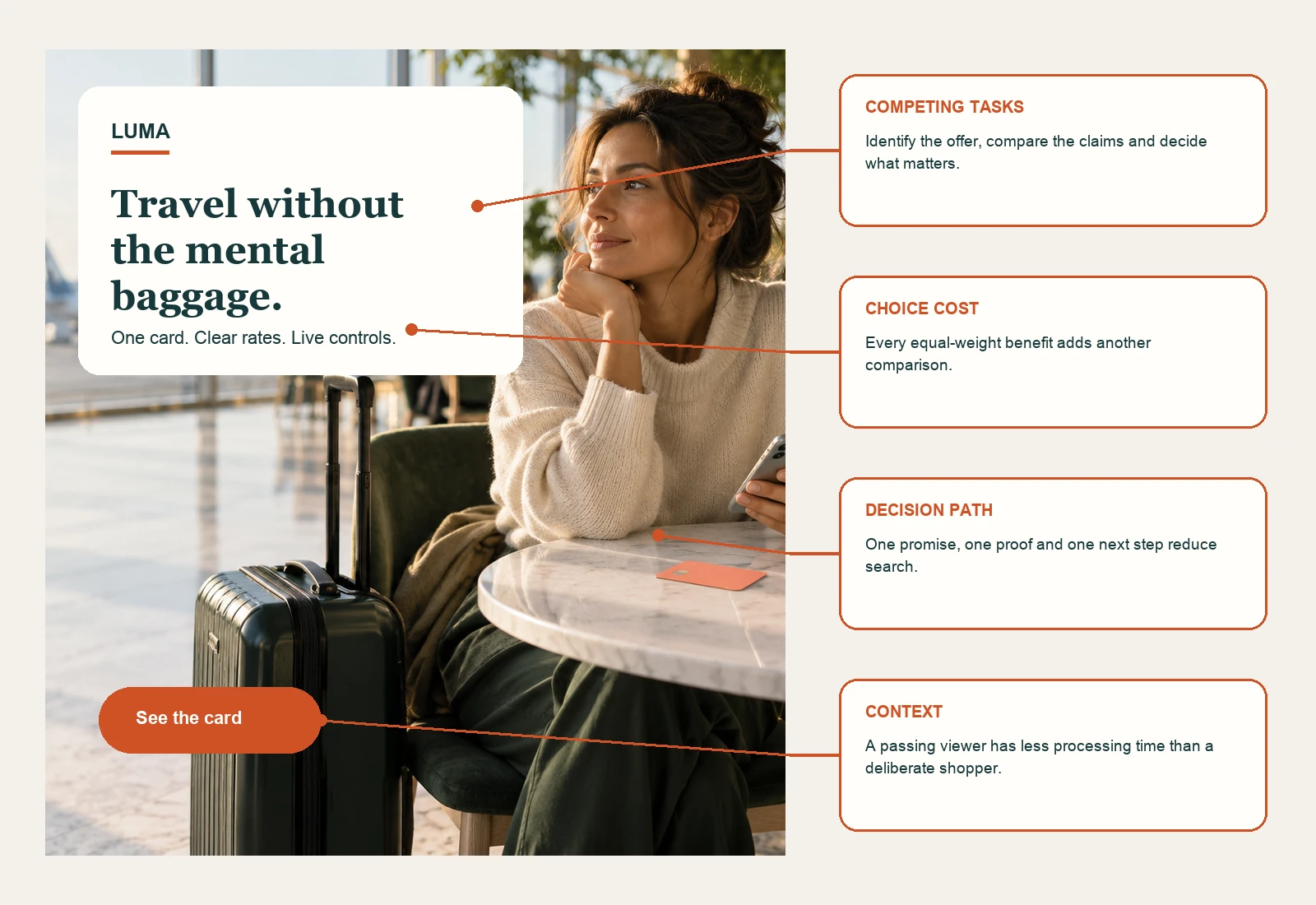
The fictional LUMA ad begins with a common strategic problem. The product team has supplied six benefits, legal has supplied two conditions, and acquisition wants both "Apply now" and "Compare plans." The first draft places every item in a similar card. It is tidy in a component-library sense, but cognitively expensive because it gives the viewer no reason to process one claim before another.
1. Define the minimum correct understanding
The ad does not need to teach the entire account. It does need the viewer to understand that LUMA is a travel payment card designed to make spending abroad easier to control. That sentence becomes a diagnostic standard. Elements that strengthen it earn prominence. Elements that answer later questions can move to the destination.
2. Reduce simultaneous comparison
Fee-free spending, live rates and card controls are not three unrelated headlines. They are evidence for the same promise. Grouping them under the proposition reduces the need to keep separate claims active and infer their relationship.
3. Preserve necessary qualification
If fee-free spending applies only up to a monthly amount, that condition must remain accessible. Reducing load does not justify a misleading headline. The qualification should appear close to the claim and in language the intended audience can understand, with the full terms available at the next step.
4. Align the action
"See the card" asks for less commitment than "Apply now" and fits an audience encountering the brand for the first time. A lower-funnel execution could legitimately choose a different action. The point is consistency between the viewer's likely state and the requested decision.
How to test cognitive demand without pretending to read minds
Cognitive load is latent: it cannot be observed directly from a screenshot or a single biometric measure. Researchers use combinations of performance, subjective ratings and physiological measures, each with limitations.
- Comprehension: ask people to explain the offer in their own words. Score the accuracy of the proposition, conditions and next step separately.
- Response time: measure how long it takes to answer a defined question, such as identifying the price or selecting the relevant plan. Faster is useful only when accuracy remains high.
- Recall and recognition: test the message, brand and proof independently. Failure to bind the claim to the advertiser is a different problem from forgetting the claim.
- Confidence: compare confidence with correctness. High confidence in a wrong interpretation is strategically important.
- Subjective effort: short mental-effort scales can compare executions, but they are retrospective reports rather than direct measures of capacity.
- Pupil dilation or EEG: these can change with effort, arousal, light, novelty and many other factors. They require controlled protocols and do not diagnose which design element caused the response.
A five-second exposure can be a useful stress test, but it is not a universal rule for advertising. Match exposure to the placement. For a menu board, test from the ordering position while other choices are present. For a product page, allow navigation and measure task completion. For video, test the sequence rather than isolated frames.
A research-informed cognitive-load review
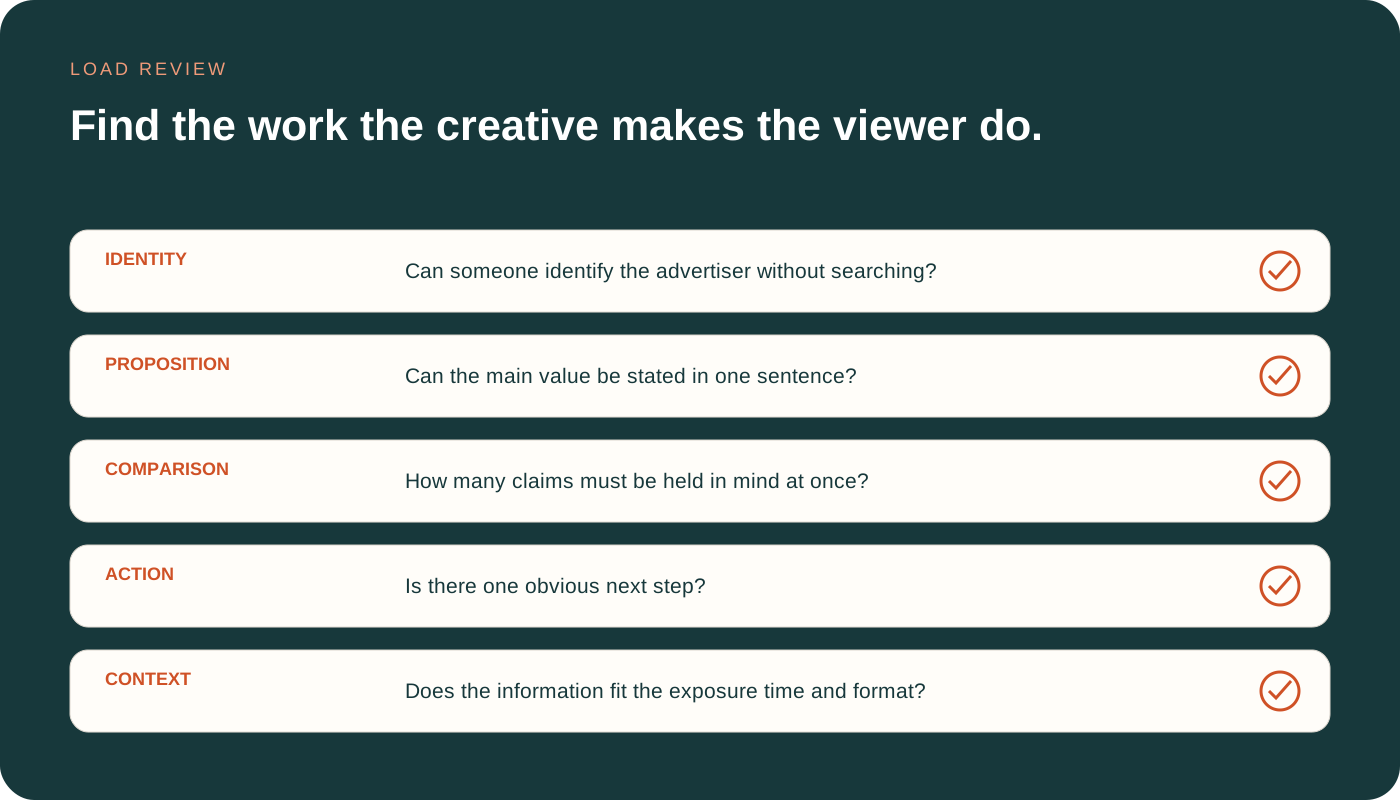
- Write the intended understanding in one sentence. If the team cannot agree on it, the creative is unlikely to resolve the disagreement for the viewer.
- List the operations required. Mark every inference, comparison, cross-reference and memory dependency.
- Separate substance from presentation. Preserve complexity that protects accuracy. Redesign complexity caused by layout or language.
- Group related evidence. Proximity, headings and sequence should reveal which proof belongs to which claim.
- Test with the intended audience. Prior knowledge changes what is familiar, what can be chunked and what must be explained.
- Test in context. Recreate distance, motion, device size, surrounding clutter and realistic time.
Common questions about cognitive load in advertising
Is a minimalist ad always easier to process?
No. Minimalism can remove category cues, evidence or instructions that the viewer needs. An ambiguous minimal ad may require more inference than an organized detailed one.
How many claims should an ad contain?
There is no universal number. Start with the decision the placement must support. Claims can coexist when their roles and relationship are clear, but every additional claim should justify the attention and comparison it requires.
Does whitespace reduce cognitive load?
Whitespace can improve grouping and reduce visual interference. It does not repair conflicting propositions, unexplained terms or a missing decision path.
Can a heatmap measure cognitive load?
No. A heatmap can describe or predict where visual attention may concentrate. It does not reveal comprehension, working-memory demand or the accuracy of the viewer's conclusion.
Should every ad have one call to action?
One primary action is often useful in short exposures. Deliberate environments can support secondary routes when their hierarchy is clear and the audience benefits from them.
The strategic value of cognitive-load analysis
A cognitive-load review is not a taste test and not an instruction to make every execution sparse. It is a way to account for mental work. The team identifies what the audience must understand, separates necessary complexity from avoidable coordination, and tests whether the viewing situation supports the task.
That changes the conversation from "there is too much here" to a more useful diagnosis: the viewer has to compare three equal claims before learning what the product is; the qualification is detached from the promise; the action asks for a decision the message has not prepared. Those are designable problems.
Research referenced
- Baddeley, A. (1992). Working memory. Science, 255(5044), 556-559.
- Sweller, J. (1988). Cognitive load during problem solving: Effects on learning. Cognitive Science, 12(2), 257-285.
- Sweller, J., van Merrienboer, J. J. G., and Paas, F. (1998). Cognitive architecture and instructional design. Educational Psychology Review, 10, 251-296.
- Lavie, N. (2005). Distracted and confused? Selective attention under load. Trends in Cognitive Sciences, 9(2), 75-82.
- Keller, K. L., and Staelin, R. (1987). Effects of quality and quantity of information on decision effectiveness. Journal of Consumer Research, 14(2), 200-213.
- Pieters, R., Wedel, M., and Batra, R. (2010). The stopping power of advertising: Measures and effects of visual complexity. Journal of Marketing Research, 47(1), 48-60.
- Pieters, R., Wedel, M., and Zhang, J. (2007). Optimal feature advertising design under competitive clutter. Management Science, 53(11), 1815-1828.
- Pieters, R., and Wedel, M. (2012). Ad gist: Ad communication in a single eye fixation. Marketing Science, 31(1), 59-73.