Persuasion in advertising: how evidence, motivation and trust change decisions
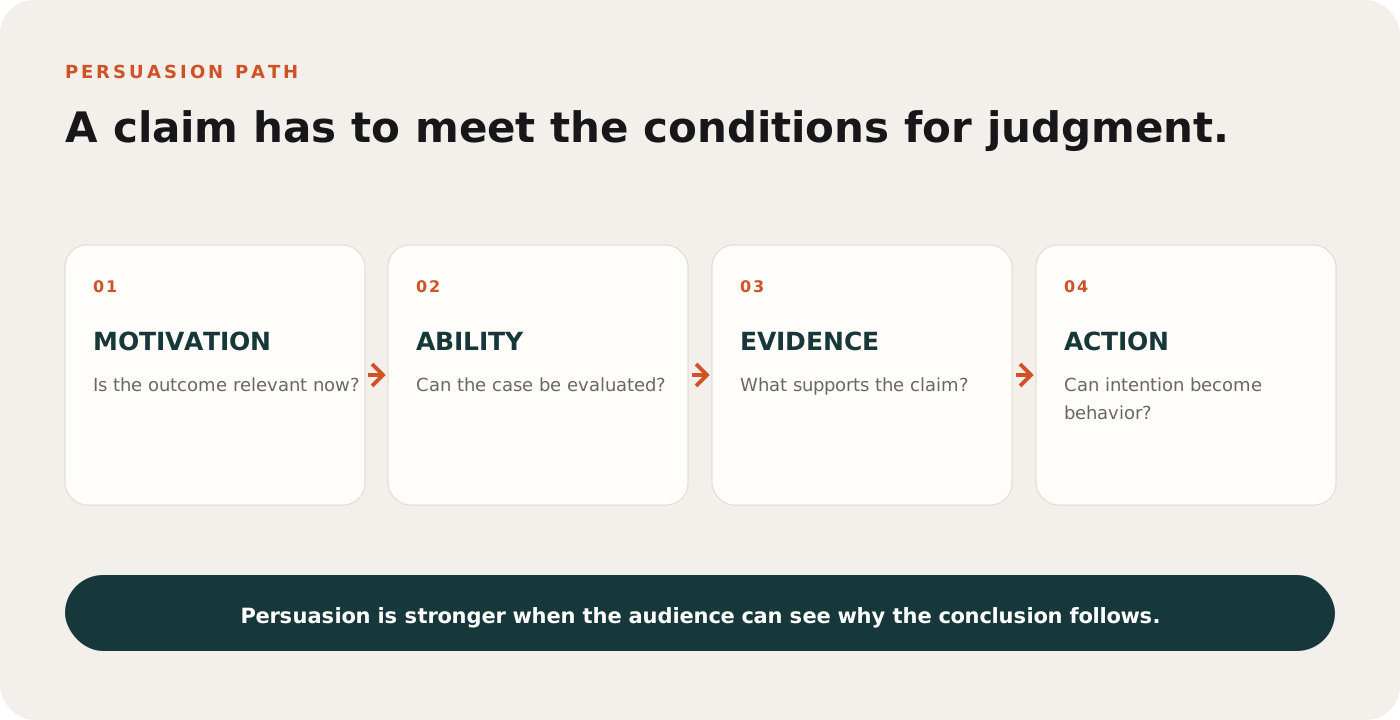
Persuasion is not a layer of force added to a message. It is the process through which people decide whether a claim deserves attention, thought, belief and action. Effective creative fits the strength of its evidence, source and request to the audience's motivation and ability to process it.
An advertisement can be clear, attractive and memorable without changing a decision. Persuasion asks a harder set of questions. Is the promised outcome relevant? Is there a credible reason to believe it? Does the action feel proportionate? What happens when the viewer recognizes the tactic and begins to resist it? The message must make that chain understandable before stylistic cues can strengthen it.
Persuasion follows different processing routes
Petty and Cacioppo's elaboration likelihood model describes persuasion as a family of processes rather than a contest between rational and emotional people. When motivation and ability are high, recipients can scrutinize arguments and connect them with prior knowledge. When either is low, judgments rely more heavily on accessible cues, learned associations and simple inferences. The same feature can play different roles under different conditions.
"When a persuasive communication was on a topic of high personal relevance, attitude change was governed by issue-relevant arguments."
Richard Petty, John Cacioppo and Rachel Goldman, Personal involvement as a determinant of argument-based persuasion, 1981
In that experiment, strong arguments mattered more when the issue was personally relevant, while source expertise mattered more under low relevance. The lesson is not that expertise is superficial or that consumers use only one route. It is that creative must match the likely processing condition. A considered enterprise purchase can support comparison and evidence. A four-second retail screen needs a compact proposition and immediately credible cues.
Motivation and ability change within the same person
Processing is not a permanent audience trait. The same buyer may scrutinize a mortgage offer, skim an energy tariff and ignore a travel promotion until a trip is booked. Personal consequence, prior knowledge, distraction, time pressure and confidence all affect the amount and direction of thought. Segmentation by demographics alone cannot establish the likely route.
This has a practical implication for channel planning. A short placement can create a credible question and a memorable source; a landing page can supply comparison and evidence; a sales conversation can resolve individual objections. Asking every exposure to complete the entire persuasive task often produces either an overloaded advertisement or an unsupported claim.

Claims need usable evidence
A reason to believe should reduce uncertainty about the promised outcome. It can be a demonstration, specification, comparison, guarantee, testimonial or independently verifiable fact. Its value depends on diagnosticity: does this evidence genuinely distinguish the offer and address the decision?
Source credibility often improves persuasion, but Pornpitakpan's review shows interactions with message, receiver and channel variables. Expertise cannot repair a weak claim. A famous endorser may attract attention while raising questions about fit or motive. A certification icon can reassure an informed buyer and mean almost nothing to someone who does not recognize it.
Social proof is evidence about behavior, not quality
Descriptive norms tell people what others do. Goldstein, Cialdini and Griskevicius found that a hotel message describing the behavior of comparable guests increased towel reuse relative to a general environmental appeal. The effect illustrates local social proof. It does not mean that any large number persuades. The reference group must be relevant, the statement must be true, and the behavior must be a useful signal.
Testimonials work through several mechanisms: similarity, expertise, vividness and evidence. Reviews can also create suspicion when they appear selected or scripted. The persuasive question is not whether social proof is present, but what inference the audience can reasonably draw from it.
Evidence has to match the claim
A demonstration is useful when the observed outcome diagnoses the advertised benefit. A before-and-after image can be vivid but uninformative if conditions change between frames. A technical specification can be precise but irrelevant if the viewer cannot connect it to an outcome. A testimonial can show experience but cannot establish population-level performance.
Good creative makes the inferential step visible. If a battery lasts longer because of a new cell design, show the mechanism and the comparison basis. If a service saves time, state which task was measured and against what alternative. The goal is not to fill the layout with substantiation. It is to choose the one piece of evidence that removes the most important uncertainty.
Framing changes how the decision is represented
Tversky and Kahneman demonstrated that equivalent outcomes can produce different preferences when framed as gains or losses. Advertising uses frames whenever it selects a reference point: money saved per month, cost per use, risk avoided, time recovered or progress made. Frames guide comparison, but their effect is conditional. Later research shows that simple rules such as "loss frames always work better" do not generalize reliably across behaviors.
A responsible frame makes the decision easier to evaluate without hiding material information. "Save 18% compared with last winter" is useful only if the comparison basis is clear. "Nine out of ten" requires a visible sample and source. The strongest frame is often the one that lets a viewer verify the claim.
Fluency can influence confidence
Information that is easier to process can feel more familiar or true, but fluency should not be confused with evidence. Clear hierarchy, concrete language and nearby proof reduce avoidable cognitive work. They should make evaluation easier, not make a weak proposition harder to question.
People interpret persuasive intent
Friestad and Wright's persuasion knowledge model describes how consumers learn about marketers' goals and tactics. When people recognize an influence attempt, they interpret both the offer and the agent behind it. Aggressive scarcity, concealed sponsorship or an implausible comparison can activate coping responses and skepticism.
This is why pressure is not the same as persuasion. A countdown timer may accelerate a genuine deadline, but a timer that resets erodes trust. A direct call to action can reduce ambiguity, but a coercive one can threaten autonomy. Ethical creative states the offer, evidence, material conditions and next step with enough clarity for a person to choose.
Attitude change is not the same as behavior
An advertisement may improve evaluation without changing action because price, availability, habit or social constraints intervene. It may also produce a click without durable belief because the action is low cost or accidental. Persuasion measurement should therefore specify the level of response: comprehension, acceptance, preference, intention, trial, repeat behavior or advocacy.
The distinction prevents teams from treating a single proxy as proof. Click-through rate can reflect curiosity. Stated intent can reflect the research situation. Sales can reflect promotion and distribution. A persuasive case is stronger when the proposed mechanism connects across measures: the claim is understood, the evidence changes belief, the belief changes choice and the effect survives outside the test.
A worked example: HALO home energy
HALO is a fictional smart thermostat and energy service. The campaign is aimed at homeowners who want comfort and cost control without becoming energy experts. Its central promise is "Comfort that uses less." The evidence is a measured comparison based on the home's own prior usage, not a universal savings guarantee.
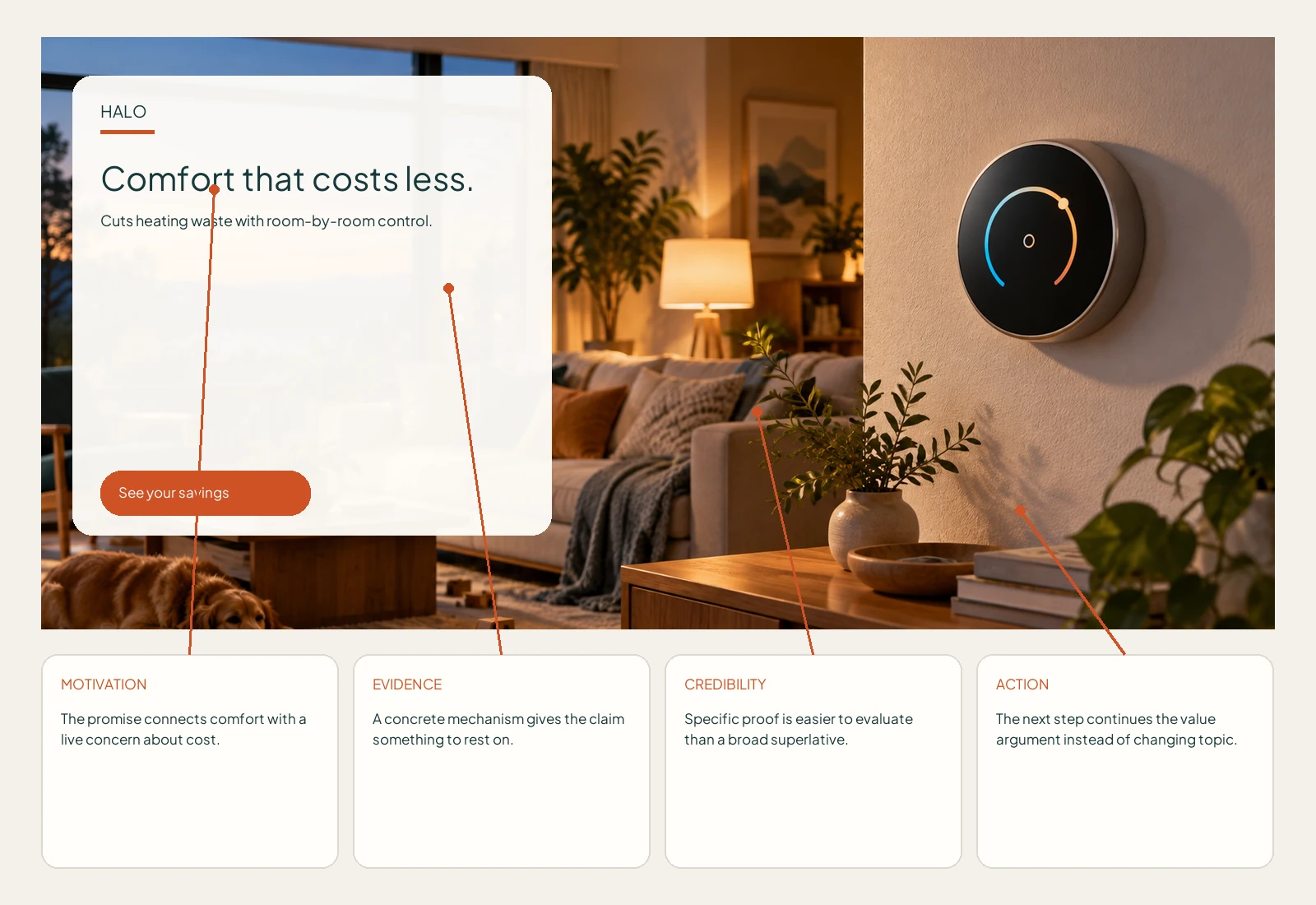
Relevant promise
Comfort leads because it is the homeowner's goal; lower energy use provides the benefit. Reversing the order would make the message sound like a technical efficiency claim with an emotional afterthought.
Bounded evidence
"See a forecast based on your last 12 months" explains what the estimate uses. It is weaker than a dramatic universal percentage but more credible and more useful.
Source
The thermostat, interface and household scene provide product evidence. A small independent verification line can support the calculation without becoming a decorative badge.
Proportionate action
"Estimate my saving" matches the evidence and level of commitment. "Buy now" would ask for a decision before the user has supplied the information needed to evaluate the claim.
Measure the mechanism, not only purchase intent
- Claim comprehension: ask people to restate the promise and conditions in their own words.
- Argument quality: compare strong and weak evidence while holding execution quality constant.
- Source inference: measure expertise, trustworthiness, motive and fit separately.
- Counterargument: record doubts and objections rather than asking only for agreement.
- Choice: use realistic alternatives, prices and consequences instead of an isolated intention scale.
- Persistence: test whether attitude change survives a delay and conflicting information.
- Behavior: measure the next meaningful step, such as opening a calculator, requesting detail or completing a trial.
What neuromarketing can add
Eye tracking can determine whether proof and conditions are seen. EEG, facial behavior or physiological measures may identify attention and arousal during a claim, but they cannot establish that the viewer believes it. Persuasion requires cognitive and behavioral measures: comprehension, credibility, counterargument, choice and persistence.
Implicit measures can help when the question concerns rapid association or when direct reporting is likely to be filtered. They still need a validated relationship to the decision of interest. A reaction-time difference should not be translated into purchase probability without evidence linking the measure to behavior in that category and population.
A research-informed persuasion review
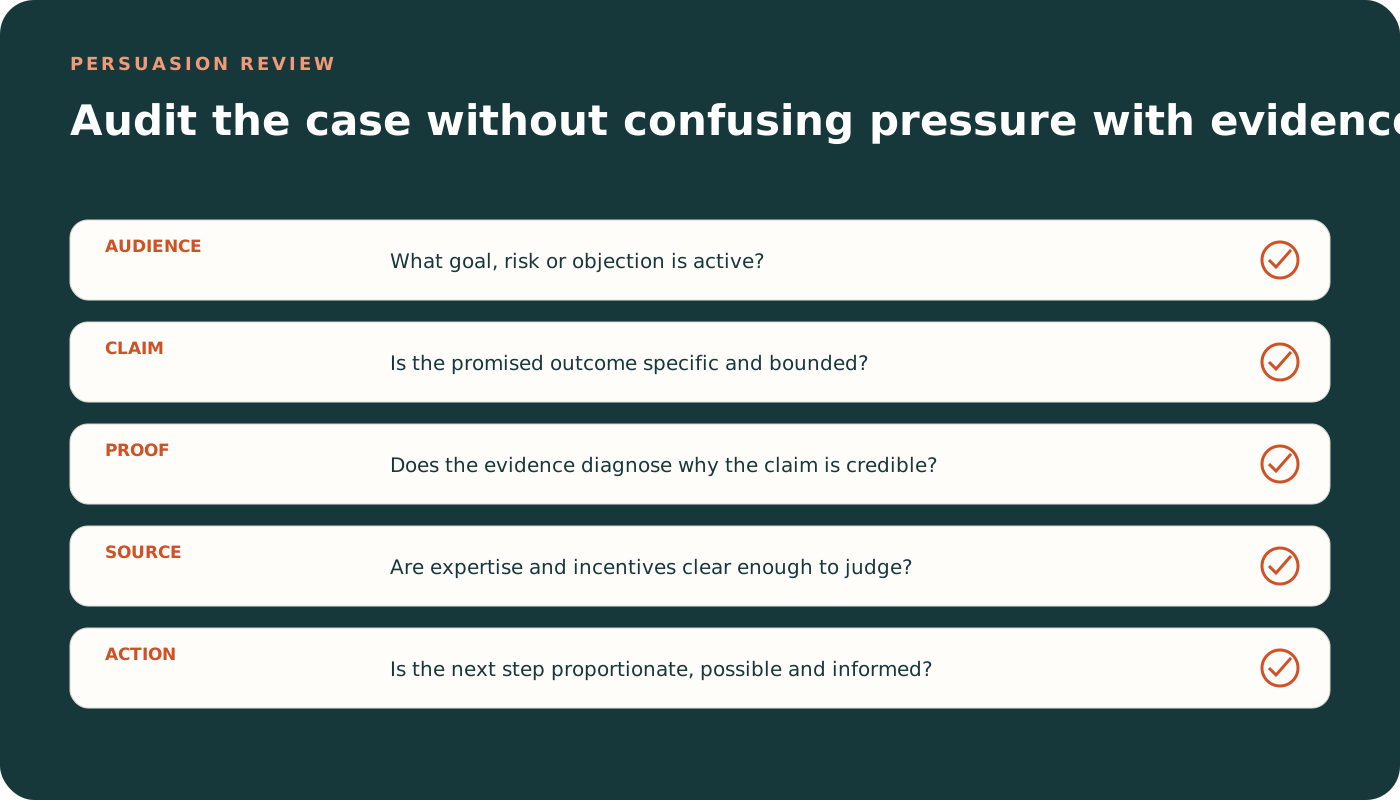
- Define the decision. Identify the specific judgment or behavior the creative is intended to influence.
- Estimate motivation and ability. Consider involvement, knowledge, time, distraction and consequence.
- State the claim precisely. Separate the promised outcome from the language used to dramatize it.
- Interrogate the evidence. Check relevance, verifiability, magnitude and conditions.
- Review the source. Test expertise, trustworthiness, fit and perceived motive.
- Anticipate resistance. Identify tactics that may trigger skepticism or threaten autonomy.
- Match the request. Make the next step proportionate to the evidence and decision stage.
- Measure durable response. Look beyond immediate liking toward choice, persistence and behavior.
Common questions about persuasion
Is emotion a shortcut around rational evaluation?
No. Emotion can signal relevance, value and consequence, and it can shape what receives thought. It does not remove the need for a credible proposition.
Does a strong call to action always improve conversion?
No. The action must match readiness and uncertainty. A high-commitment request can suppress response when the creative has not supplied enough evidence.
Should advertising use loss framing?
Only when the frame is accurate, relevant and tested. Evidence does not support a universal rule that losses outperform gains.
Can AI predict persuasion?
AI can assess claim structure, evidence visibility, credibility cues, friction and common resistance triggers. Actual attitude and behavior change require audience and outcome data.
Research referenced
- Petty, R. E., and Cacioppo, J. T. (1986). The elaboration likelihood model of persuasion. Advances in Experimental Social Psychology, 19, 123-205.
- Petty, R. E., Cacioppo, J. T., and Goldman, R. (1981). Personal involvement as a determinant of argument-based persuasion. Journal of Personality and Social Psychology, 41(5), 847-855.
- Friestad, M., and Wright, P. (1994). The persuasion knowledge model: how people cope with persuasion attempts. Journal of Consumer Research, 21(1), 1-31.
- Pornpitakpan, C. (2004). The persuasiveness of source credibility: a critical review of five decades' evidence. Journal of Applied Social Psychology, 34(2), 243-281.
- Tversky, A., and Kahneman, D. (1981). The framing of decisions and the psychology of choice. Science, 211(4481), 453-458.
- Goldstein, N. J., Cialdini, R. B., and Griskevicius, V. (2008). A room with a viewpoint: using social norms to motivate environmental conservation in hotels. Journal of Consumer Research, 35(3), 472-482.