Context fit in advertising: how place, moment and media change the message
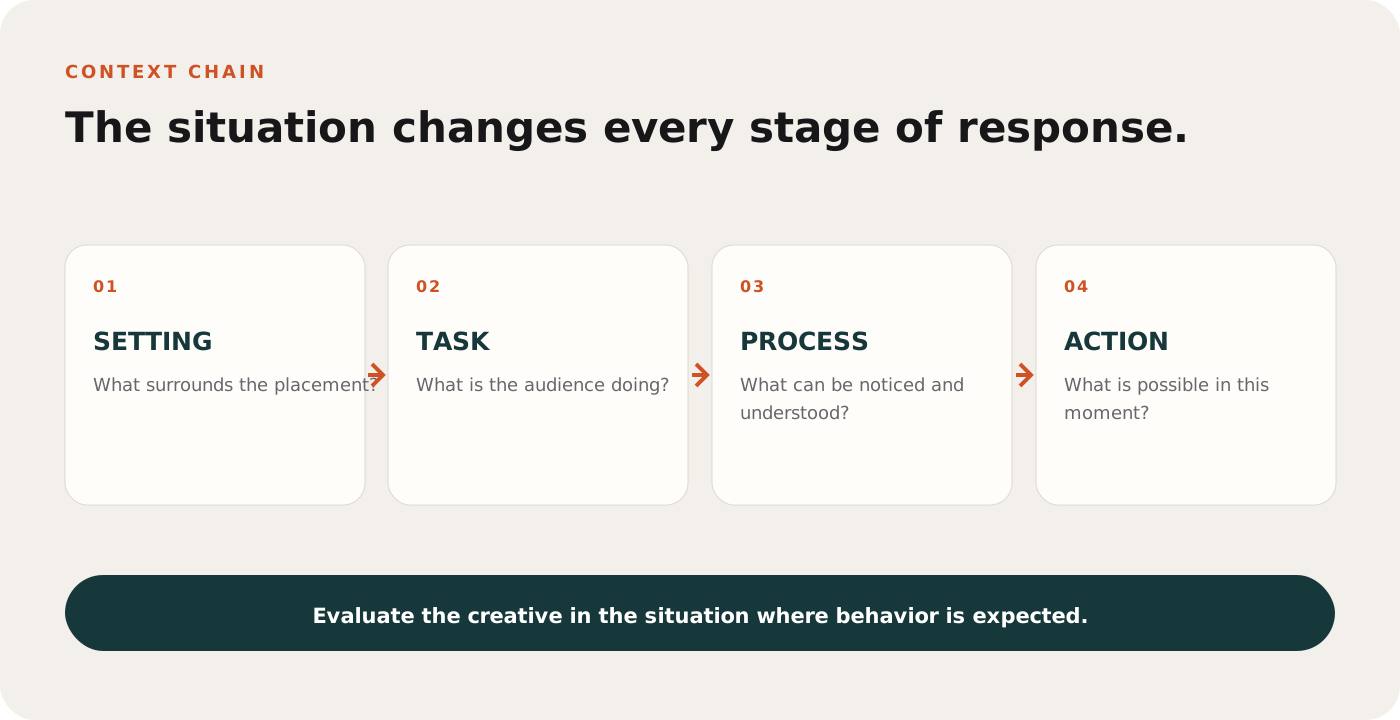
An advertisement is never encountered in isolation. It appears inside a place, a medium, a task and a moment. Context fit describes how well the creative works with those conditions: whether it can be noticed, understood, believed and acted on by the people who meet it there.
The same execution can be clear on a product page and unreadable on a station screen. A humorous line can feel welcome beside entertainment and careless beside distressing news. A detailed comparison can help a deliberate shopper and obstruct someone moving through an airport. These are not minor delivery issues. They change the psychological conditions under which the message is processed.
Context fit is therefore broader than media placement. It includes the physical environment, the audience's current goal, likely viewing time, device and format, surrounding content, cultural knowledge, time of day and the action available after exposure. Good fit does not mean making an advertisement disappear into its surroundings. It means designing the right relationship between message and situation.
Context is a set of interacting layers
Marketers often use context to mean the page, program or platform surrounding an advertisement. That editorial layer matters, but it is only one part of the exposure. A useful analysis separates at least six layers:
- Media context: the article, program, feed, search result or retail environment surrounding the placement.
- Physical context: viewing distance, lighting, motion, noise, crowding and competing objects.
- Task context: what the person is trying to do when the advertisement appears.
- Temporal context: the time available, time of day, season and position in a journey or decision.
- Cultural context: the language, conventions, symbols and category knowledge used to interpret the message.
- Action context: whether the proposed next step is possible and appropriate at that moment.
These layers interact. A six-second digital out-of-home placement is not merely a short video. It may be seen by someone walking, looking for a gate, carrying luggage and monitoring a departure time. A product claim that works in a quiet comparison table may not survive that divided attention. The relevant unit of analysis is the creative-in-situation, including the viewing conditions that determine readability.

Congruence changes processing, but fit is not sameness
Research on media context has repeatedly asked whether an advertisement benefits when it matches the surrounding content. The answer depends on what kind of match is meant and which outcome is measured. Congruence can make a message easier to integrate with active thoughts. It can support fluency, relevance and favorable evaluation. It can also make the advertisement less distinctive if it becomes too similar to its surroundings.
Incongruence can interrupt routine processing and increase attention. That extra attention does not guarantee persuasion. It may produce curiosity, confusion or irritation. A placement can therefore improve recall while weakening attitude, or attract a fixation without improving comprehension. The practical question is not whether fit is universally good. It is which relationship between creative and context serves the objective.
"Low involvement persons perceived ads embedded in a congruent context as clearer and more likable."
De Pelsmacker, Geuens and Anckaert, Media context and advertising effectiveness, 2002
Research also distinguishes thematic fit from emotional fit. A travel service beside travel content is thematically congruent. A calm message inside a reflective program is emotionally congruent. These dimensions can move independently. A relevant category match delivered in an emotionally jarring moment may still feel wrong.
Placement can alter what the brand means
Russell's work on product placement describes how connection to a narrative can influence memory and attitude. A brand integrated into a story is not processed in the same way as a detached commercial break. More broadly, the environment can lend associations to an advertiser. A financial message in a trusted specialist publication, a food offer at a point of hunger and a travel service near departure cues each acquire meaning from the setting.
That transfer can help or harm. Context effects should be treated as hypotheses about association, not automatic endorsements. Familiar surroundings can increase credibility for one audience while signaling irrelevance to another. Measurement needs to include source attribution and brand meaning, not exposure alone.
Attention depends on the audience's task
People allocate attention in pursuit of goals. At an airport, the primary task may be finding a gate. In a supermarket, it may be locating a planned item while comparing price. On a phone, it may be replying to a message or passing time. Advertising competes with these goals and sometimes becomes useful to them.
This distinction changes creative design. When the audience is moving, the first meaningful unit must be identifiable at a glance. When the audience is deliberately researching, evidence and comparison can reward sustained inspection. When the audience is waiting, richer storytelling may be possible. The amount of available time should be inferred from behavior, not from the technical maximum duration of the placement.
Relevance can reduce search
A contextually relevant message can lower the cost of deciding whether to engage. The setting answers part of the question "Why is this for me now?" A roaming offer at an international departure gate has an immediate situational cue. The same offer on a commuter platform needs more work to establish relevance.
Relevance is not an excuse to add detail. A relevant message can still fail if type is too small, hierarchy is unclear or the next step is impossible. Context fit works with attention, hierarchy, readability, message and cognitive load. It cannot compensate for weaknesses in those domains.
Place, format and culture change meaning
Creative conventions are learned. Colors, gestures, humor, reading direction, privacy expectations and category symbols do not carry identical meanings everywhere. A visual metaphor that feels immediate to one group may be opaque to another. Translation preserves words; localization preserves intended interpretation and action.
Format also communicates. A short vertical video implies a different relationship from a premium magazine spread. A search advertisement arrives during declared intent. A digital out-of-home screen occupies shared public space. The advertiser's claim may be identical, but the perceived intrusiveness, credibility and expected level of detail can change.
Design for the consequence of the medium
Each format creates characteristic losses. Outdoor reduces fine detail and viewing control. Social feeds reduce guaranteed attention and sound. Retail increases proximity to action but also comparison and sensory competition. Email permits depth but arrives inside a task-oriented inbox. Effective adaptation protects the strategic core while rebuilding the execution for the losses and opportunities of each medium.
Mechanical resizing is therefore rarely sufficient. The same creative idea may require a new crop, a shorter promise, stronger source cues, different proof and a different action. Consistency should live in the memory structure of the campaign, not in identical layouts.
A worked example: ROAM airport connectivity
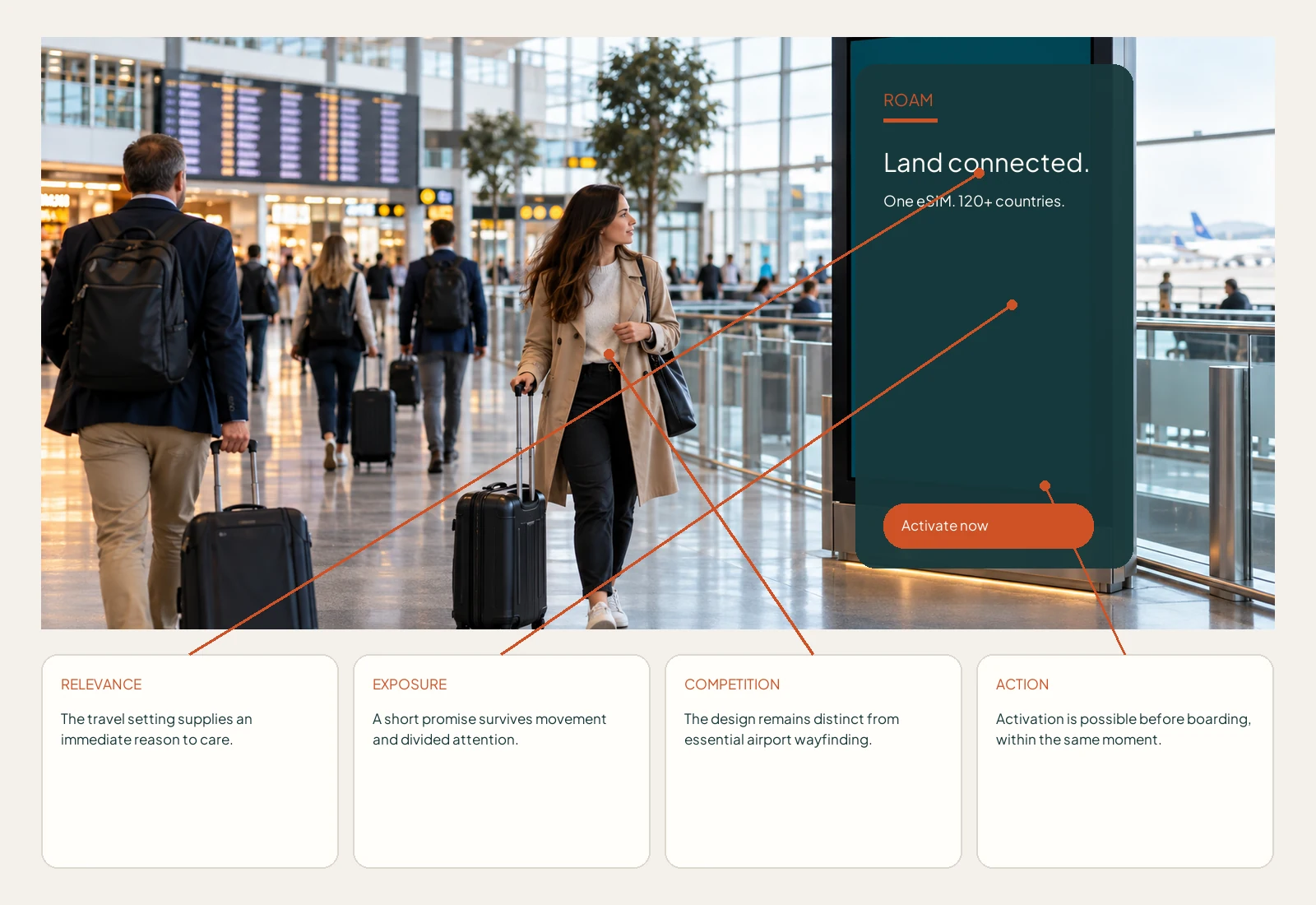
ROAM is a fictional eSIM service. The placement is a digital screen in an international airport concourse. Travelers are moving, checking signs and anticipating connectivity on arrival. That situation gives the offer relevance, but the screen must not compete with wayfinding or demand prolonged reading.
Situational promise
"Land connected" names the outcome in two words and connects it to the journey. It does not ask the viewer to learn a technical category before understanding the benefit.
Concrete proof
"One eSIM. 120+ countries" makes the offer more diagnostic. It answers what the service is and why it may be useful without becoming a feature list.
Exposure conditions
The main message uses a large quiet field and high contrast. Secondary copy is restricted because many viewers will encounter the screen obliquely and for only a few seconds.
Action at the right moment
"Activate before takeoff" describes an achievable next step. A QR code can support the action, but the domain or app name should remain available for viewers who cannot stop and scan.
How to measure context fit
Context fit cannot be validated only in a design file or a neutral research room. Evaluation should reproduce the constraints that define the exposure. That does not always require a full field study, but it does require the right tasks, time and competing stimuli.
- Context reconstruction: test the creative inside a realistic feed, page, store, street or journey rather than as an isolated image.
- Task compatibility: observe whether the advertisement helps, interrupts or remains irrelevant to the audience's active goal.
- Timed comprehension: measure what can be understood within plausible exposure, including brand and action.
- Visual-angle review: reproduce size, distance, motion and angle for physical placements.
- Association test: assess whether the surrounding content changes perceived meaning, trust or category expectations.
- Localization test: use participants with relevant language and cultural knowledge; do not infer equivalence from translation.
- Action-path test: verify that scanning, clicking, searching, visiting or buying is practical in the moment.
- Field comparison: compare matched placements or creative variants using outcomes appropriate to the objective.
What neuromarketing measures can add
Eye tracking can reveal whether attention shifts from the environment to the advertisement and whether essential regions are inspected. EEG and peripheral measures may indicate changes in arousal, engagement or workload under controlled comparisons. These tools are most useful when the contrast is clearly defined: congruent versus incongruent context, low versus high clutter, or stationary versus moving exposure.
They do not identify the meaning of a response by themselves. Increased arousal may reflect relevance, surprise, stress or difficulty. A fixation can reflect interest or failed understanding. Behavioral outcomes and self-report remain necessary to establish comprehension, attribution, evaluation and intent. Field behavior is needed when the commercial claim concerns real action.
A research-informed context review
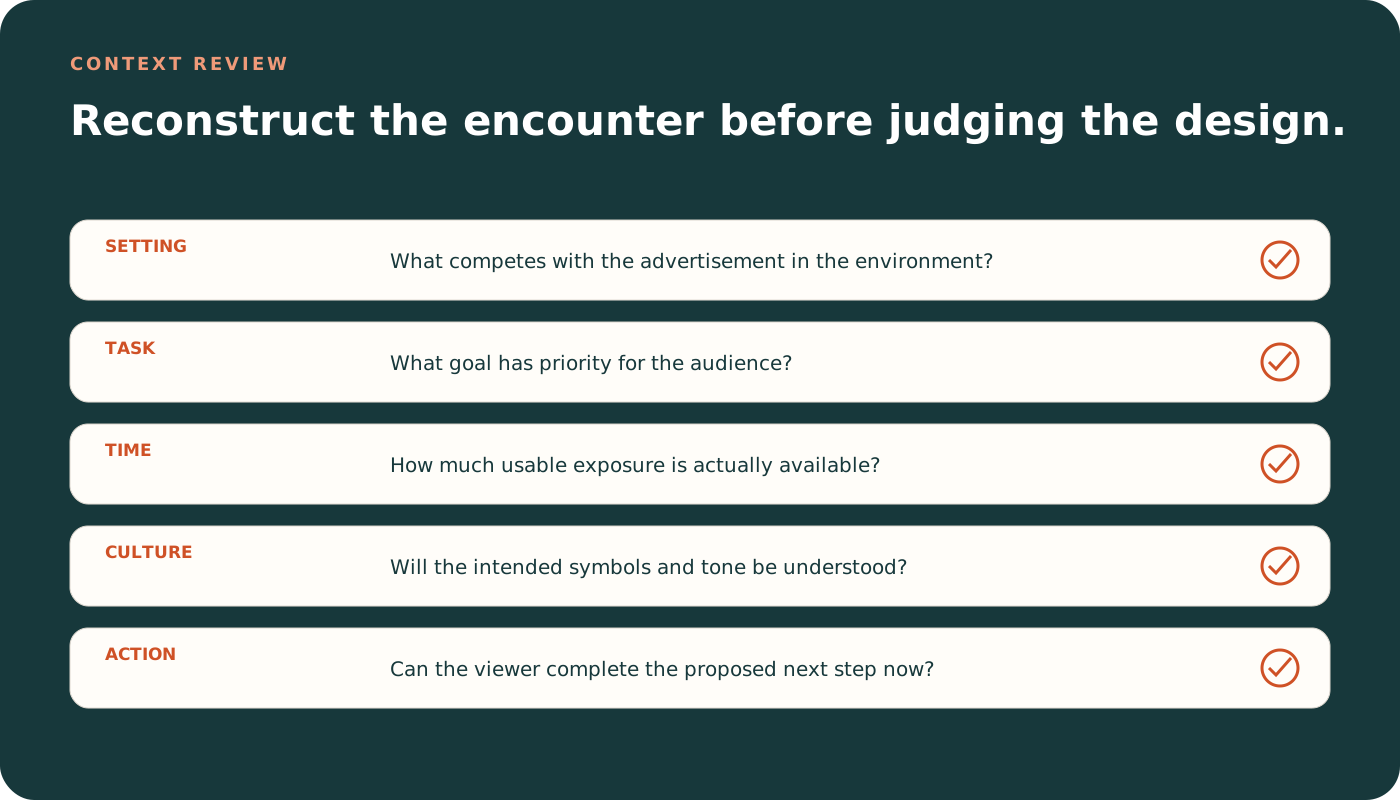
- Describe the real encounter. State where the creative appears, what surrounds it and how people move through the setting.
- Name the audience's active task. Identify what they are trying to achieve before the advertisement intervenes.
- Set a realistic exposure window. Use observed behavior rather than the media file's duration.
- Define the useful relationship. Decide whether congruence, contrast or interruption should do the work.
- Protect comprehension. Adapt type, message length, hierarchy and proof to the environment.
- Check cultural interpretation. Test language, symbols, humor and norms with relevant people.
- Make action possible. Match the requested next step to device, motion, privacy and available time.
- Measure in context. Pair attention data with comprehension, brand attribution and behavior.
Common questions about context fit
Should an advertisement always match its environment?
No. Congruence can support relevance and fluency; incongruence can attract attention. The right choice depends on whether the resulting attention produces useful understanding, attribution and response.
Is contextual advertising the same as personalization?
No. Contextual advertising uses features of the environment or content. Personalization uses information about an individual or segment. They can overlap, but they raise different measurement and privacy questions.
Can one master creative work in every channel?
The strategic idea can travel, but the execution usually needs adaptation. Viewing conditions, interaction and audience task change across channels.
How does Optiks.ai assess context fit?
Optiks.ai reviews the relationship between creative, channel, asset type, objective and plausible viewing conditions. The assessment should be treated as structured evidence for review and testing, not as a substitute for market-specific behavioral data.
Apply these ideas to roadside and pedestrian placements with the billboard design best-practices guide.
Research referenced
- Kumar, A. (2000). Interference effects of contextual cues in advertisements on memory for ad content. Journal of Consumer Psychology, 9(3), 155-166.
- Russell, C. A. (2002). Investigating the effectiveness of product placements in television shows: the role of modality and plot connection congruence on brand memory and attitude. Journal of Consumer Research, 29(3), 306-318.
- Dahlen, M. (2005). The medium as a contextual cue: effects of creative media choice. Journal of Advertising, 34(3), 89-98.
- De Pelsmacker, P., Geuens, M., and Anckaert, P. (2002). Media context and advertising effectiveness: the role of context appreciation and context/ad similarity. Journal of Advertising, 31(2), 49-61.
- Moorman, M., Neijens, P. C., and Smit, E. G. (2002). The effects of magazine-induced psychological responses and thematic congruence on memory and attitude toward the ad in a real-life setting. Journal of Advertising, 31(4), 27-40.
- Garcia-Madariaga, J., et al. (2021). The effects of congruence of background music on consumer behavior: a neurophysiological study. European Research on Management and Business Economics, 27(2), 100154.