The best ad creative testing tools: what each type of platform actually measures
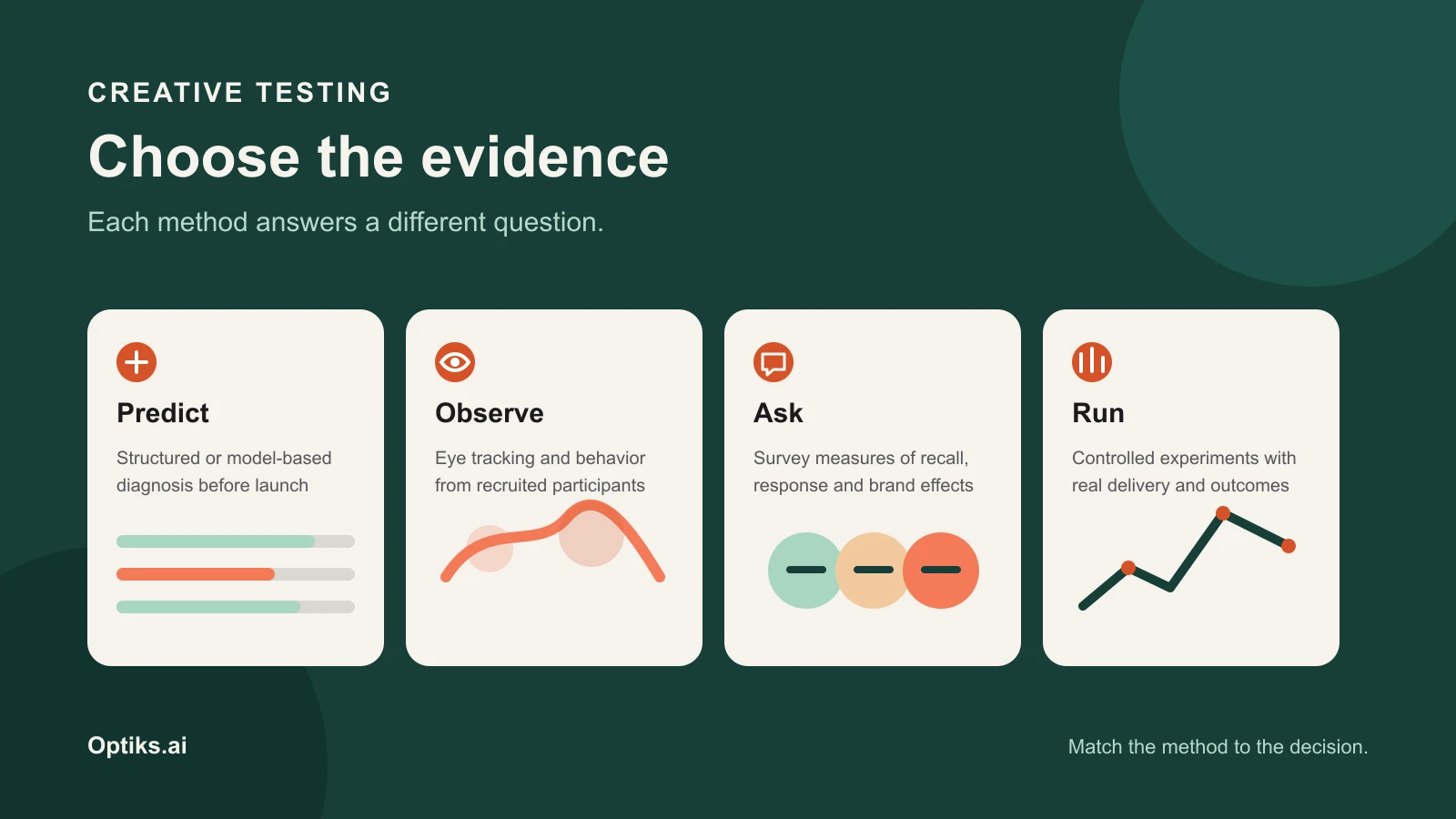
The best ad creative testing tool is the one that produces the evidence your decision requires. An AI diagnosis, an eye-tracking study, a consumer survey and a live A/B test do not compete to answer the same question. They reveal different parts of how creative may work.
A long feature list can hide this distinction. A platform may generate an attention heatmap in seconds, but that does not mean it has observed your audience. A survey can measure brand response, but it may not show which layout detail caused confusion. A live test can identify a stronger outcome without explaining why one version won.
This guide compares creative testing tools by method, evidence and practical use. The named products are illustrative examples, not paid placements or affiliate recommendations. Features change, so confirm current formats, access and methodology with each provider before buying.
Start with the decision, not the tool
Creative teams often ask one broad question: “Will this ad work?” No single tool can answer it without defining what “work” means. The useful question could concern readability, attention, comprehension, emotion, brand attribution, purchase intent, click-through rate, incremental sales or another outcome.
Before comparing platforms, write the decision in one sentence. For example:
- Which of three early concepts should move into production?
- Can viewers read the offer from the intended distance?
- Does the audience connect the story to the correct brand?
- Which video creates greater brand lift under controlled delivery?
- Why does one live asset have a higher conversion rate than another?
Those questions require different evidence. A structured pre-launch review can identify execution risks. Eye tracking can show whether participants looked at the logo. A survey can test whether they remembered the advertiser. A randomized experiment can estimate whether the campaign changed an outcome. Treating these as interchangeable creates false certainty.
For a broader process that begins with the decision and works backward to the method, see creative testing before launch. For a method-design guide, compare AI analysis, surveys, eye tracking and live A/B tests.
Ad creative testing tools compared
| Tool or platform | Core method | What it measures or produces | Best used for | What it does not establish alone |
|---|---|---|---|---|
| Optiks.ai | AI-assisted, research-informed creative diagnosis | Effectiveness score, eleven-domain Creative Fingerprint, benchmarks, viewing context and prioritized recommendations | Fast pre-launch review, version comparison and structured team discussion | Observed gaze, stated consumer response or incremental campaign effect |
| Neurons AI | Predictive models trained on human neuroscience and eye-tracking data | Predicted attention, emotion, cognition, memory and element-level visualizations | Rapid attention diagnosis and iteration across many assets | How the intended campaign audience actually responds to this exposure |
| Tobii Sticky / Tobii Pro | Webcam or hardware eye tracking with participants | Observed gaze, fixations, attention to areas of interest and viewing patterns | Testing whether important elements are seen and how visual attention unfolds | Comprehension, liking, persuasion or sales without added measures |
| Kantar LINK+ / LINK AI | Consumer survey testing and AI prediction based on normative data | Brand and sales-related measures, engagement, associations and creative diagnostics | Audience response, brand effects, norms and decisions with higher commercial stakes | Incremental in-market results for the final media plan |
| Ipsos Creative|Spark / Creative|Spark AI | Consumer research, behavioral and facial measures, plus AI prediction | Branded attention, short- and long-term effects, emotion and diagnostic guidance | Finished or developing work where consumer response and brand impact matter | Guaranteed campaign performance in the eventual market context |
| Google Ads Experiments | Randomized live campaign experiments | Differences in campaign metrics, conversions and, where eligible, brand lift | Testing creative under real delivery against a defined outcome | A general diagnosis of why the winning creative worked |
| TikTok Creative Center | Library of authorized high-performing platform ads | Examples, filters and performance-pattern inspiration | Category research, ideation and understanding platform conventions | A test of your creative; it is an inspiration and analysis resource |
The table deliberately mixes products with different methods. That is the point: the right shortlist starts with the evidence category. Pricing is excluded because enterprise configuration, markets, sample design, service level and feature access can change the commercial comparison quickly.
1. AI creative diagnosis: fast, broad and useful for iteration
AI creative analysis examines an asset and generates structured judgments, predictions or recommendations. It is most useful when teams need feedback before media spend, need to compare versions consistently or want to turn an unstructured review into a clear revision brief.
Optiks.ai reviews creative across eleven connected domains: attention, hierarchy, readability, cognitive load, message, emotion, brand, color, composition, persuasion and context fit. It considers the objective, asset type, channel and context supplied by the user, then returns a score, Creative Fingerprint and prioritized action steps. It can also compare versions and connect later campaign results to the analysis.
The strength of this method is breadth and speed. It can identify that a prominent offer is difficult to read, that the brand is weakly linked to the message or that an execution may not suit the placement. It gives designers and marketers specific hypotheses to examine.
Its limit is equally important: it does not directly record a person looking, feeling, remembering or buying. The output is a research-informed diagnosis, not a sample of consumer behavior. Use it to find questions, improve execution and prioritize further testing. Do not present the score as observed market performance.
Choose AI diagnosis when:
- You need feedback within the creative workflow.
- You have many versions or formats to review consistently.
- The team needs actionable recommendations, not only a heatmap.
- The main risk concerns execution, context or the relationship among creative elements.
2. Predictive attention and neuroscience models: scalable visual evidence
Predictive attention platforms use models trained on human data to estimate how people may distribute visual attention. Depending on the product, they may add predicted cognitive demand, engagement, memory or emotion measures.
Neurons AI says its models draw on eye tracking and other consumer-neuroscience data. Its current product materials describe attention heatmaps, areas of interest and predictions related to attention, emotion, cognition and memory. The platform is designed for quick comparison and optimization of images and video.
This category is valuable when teams need to screen many assets or inspect whether a logo, product, headline or call to action is likely to receive visual attention. It can be much faster than recruiting a new sample for every iteration.
A predicted heatmap is still a model output. Even observed gaze is not equivalent to comprehension or persuasion; a viewer may look at a price because it is confusing, because it is attractive or because it interrupts reading. Neurons’ own materials distinguish several attention measures, which is a useful reminder that “attention” is not one number.
Use predictive attention as a focused visual diagnostic. Combine it with message, brand and audience evidence when the decision extends beyond noticing.
3. Human eye tracking: observe where participants look
Eye tracking records gaze behavior from recruited participants. Lab equipment can provide controlled, high-frequency data; wearable glasses can capture movement through stores or public environments; webcam approaches can support remote studies at larger scale.
Tobii Sticky uses webcam-based eye tracking for ads, video, websites and packaging. Tobii also provides hardware and research services for lab and real-world studies. Outputs can include fixations, viewing sequences, time to first fixation and attention to defined areas of interest.
Eye tracking is a strong choice when the question is behavioral and visual: Did people look at the brand? Was the call to action found? Which element attracted the first fixation? Did the viewer scan the promotion in the intended order?
Study design matters. Tobii’s own guidance notes that data quality depends on the participant, calibration, equipment, environment and processing. It also cautions that a longer fixation can reflect interest, effort, confusion or another process, so gaze should be interpreted in context and often combined with task, interview or survey measures.
For a full explanation of samples, areas of interest, natural exposure and common interpretation errors, read eye tracking in advertising.
4. Consumer ad testing: measure audience response and brand effects
Consumer testing exposes recruited people to advertising and measures responses such as recall, comprehension, association, emotion, brand linkage, consideration or purchase intent. The strongest studies match the sample, context and metrics to the campaign decision.
Kantar LINK+ and LINK AI
Kantar LINK+ is a configurable consumer ad-testing system. Kantar describes core components covering engagement, associations, short-term sales impact and long-term brand-equity contribution, with optional creative diagnostics and neuroscience features. It supports work from early storyboards to finished assets.
LINK AI is a separate predictive option trained on Kantar’s advertising-response data. Kantar says it predicts likely human response and supports formats including video and static advertising. The distinction matters: LINK+ gathers responses from a study sample, while LINK AI predicts from an existing evidence base.
Ipsos Creative|Spark and Creative|Spark AI
Ipsos Creative|Spark combines survey and behavioral measures to assess branded attention and short- and long-term effects. Ipsos describes facial coding as part of the human-research offer and supports multiple formats, including video, social, OOH, print and audio.
Creative|Spark AI predicts responses for supported video formats using models based on Ipsos’ human-response database. Ipsos positions it as a faster, lower-cost complement to its consumer research, not as evidence gathered from a new audience sample.
Consumer testing is usually the more appropriate choice when management needs evidence about actual audience understanding or brand response, particularly for high-investment launches. It takes more setup than an automated diagnosis and depends on sample quality, questionnaire design, exposure context and the validity of the metrics.
5. Live platform experiments: test outcomes under real delivery
Live experiments divide eligible traffic between creative conditions and compare outcomes. When assignment and implementation are controlled, this is the most direct method in this list for estimating how creative changes an in-market metric.
Google Ads Experiments supports several experiment types. Its current documentation describes ad variations, custom experiments, Demand Gen experiments and video experiments. Video experiments can compare creative against metrics including view rate, conversions and, for eligible accounts, brand lift.
The method requires enough traffic, budget and time. Google advises that some experiments may need four to six weeks to collect enough data. A weak design can also produce a misleading result: if audience, bid, placement, landing page and creative all change together, the experiment cannot isolate the creative explanation.
Live tests tell you what happened under the tested delivery conditions. They often do not explain why. A stronger workflow uses pre-launch diagnosis to form a specific hypothesis, changes one important variable, then uses the campaign experiment to test the predicted outcome.
Platform libraries can support ideation but should not be confused with experimentation. For example, TikTok Top Ads provides authorized high-performing creative examples and frame-level performance patterns. It can reveal conventions worth investigating, but another advertiser’s result is not a controlled test of your brand, offer or audience.
How to choose a creative testing platform
1. Specify the evidence you need
Write whether the decision needs a prediction, an observation, a stated response or an outcome. If the team wants to know whether the logo is likely to be noticed, an attention method may fit. If the decision concerns correct brand attribution, add a response measure. If it concerns incremental sales, design an outcome study.
2. Match the method to the creative stage
Early concepts benefit from fast diagnosis because large changes are still affordable. Near-final work may justify consumer evidence. In-market creative can be optimized with controlled experiments. Do not wait for an expensive method to answer a question that should have been resolved in the layout, and do not use a cheap proxy when the commercial decision requires audience evidence.
3. Ask what the benchmark represents
A percentile is useful only when the comparison set is relevant and sufficiently large. Ask whether norms match the channel, format, objective, category, market and scoring version. A broad benchmark can provide context, but it should be labeled as broad rather than presented as a precise category standard. See how Optiks.ai approaches creative benchmarking.
4. Inspect the input and context
A tool that accepts only the image may miss the objective, audience, viewing distance or placement. A survey that presents an outdoor ad full-screen for a long period may overstate readability. Ask how closely the test reproduces the real encounter and which contextual facts the platform uses.
5. Understand the output
Scores, heatmaps and norms are not recommendations by themselves. Look for a clear explanation of what each metric means, how uncertainty is handled and what action the team can reasonably take. The output should help a decision, not add a decorative dashboard.
6. Check governance and repeatability
Ask how assets and brand data are handled, who can access results, whether tests can be repeated with the same settings and whether scores remain comparable after model updates. Enterprise teams may also need APIs, permission controls, market-level norms and exportable evidence.
Build an evidence stack instead of searching for one perfect score
A practical creative-testing program can use several methods without applying every method to every asset. Escalate the evidence with the value and uncertainty of the decision.
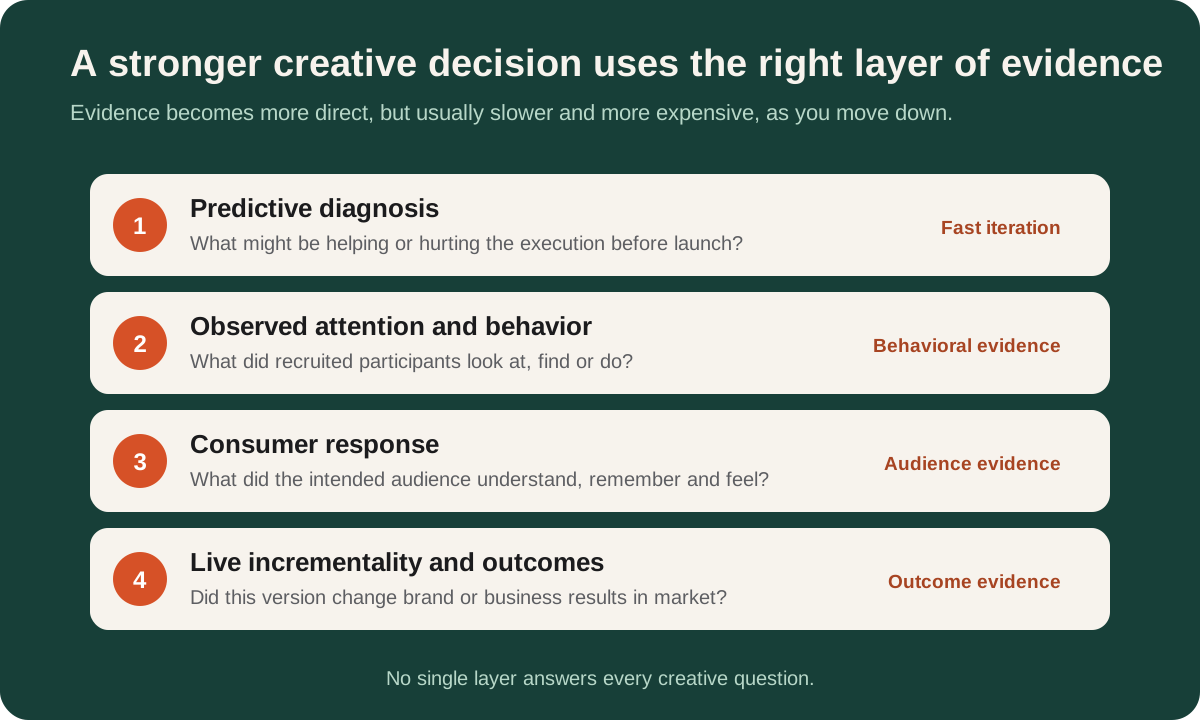
- Diagnose widely. Review all viable assets for objective, hierarchy, readability, brand attribution and context.
- Observe selectively. Use eye tracking or behavioral tasks when visual discovery is a material uncertainty.
- Ask the audience. Use consumer research for understanding, memory, feeling and brand effects.
- Validate in market. Use a controlled experiment and predefined outcome when delivery volume permits.
- Feed the learning back. Record which creative hypotheses were supported, then improve the next brief and test plan.
This approach also prevents a common mistake: asking a fast pre-launch score to carry the evidential burden of a sales test. Each layer contributes something useful when its claim stays within its method.
Frequently asked questions
What is the best ad creative testing tool?
The best tool depends on the decision. Optiks.ai is designed for structured pre-launch diagnosis and recommendations. Neurons AI focuses on predictive attention and neuroscience measures. Tobii supports observed eye tracking. Kantar and Ipsos provide consumer-response systems and predictive options. Google Ads Experiments measures live campaign differences. Important decisions may use more than one.
Can AI replace consumer ad testing?
No. AI can make fast, repeatable predictions or diagnoses, but it does not directly observe how the intended audience responds to the campaign. Use consumer research when actual understanding, feeling, memory or intent is central to the decision.
Is an attention heatmap enough to judge an ad?
No. Attention is necessary for many effects, but it is not sufficient. Looking at an element does not prove that the person understood it, connected it to the brand or became more likely to act.
Should I use consumer surveys or live A/B tests?
Use surveys to diagnose audience response, including understanding, recall, associations and emotion. Use live experiments to estimate a difference in an in-market outcome under controlled delivery. The methods can complement each other.
When is a free creative tool useful?
Free libraries such as TikTok Creative Center are useful for examples, format conventions and hypothesis generation. They do not test your own execution. A low-cost first step is to use inspiration to form a clear hypothesis, then test the actual creative with a method matched to the decision.
Sources and methodology
Product capabilities were checked against provider materials available on 3 November 2026. Provider statements describe their own products and should not be read as independent validation. No company paid for inclusion, and Optiks.ai is identified as the publisher’s product. The comparison evaluates method fit rather than declaring one universal winner.
- Optiks.ai. AI creative analysis. Product method, domains and limitations.
- Neurons. Neurons AI. Provider description of predictive attention, emotion, cognition and memory capabilities.
- Tobii. Eye tracking guide: how it works and what it measures. Data quality and interpretation guidance.
- Tobii. Tobii Sticky. Provider description of remote webcam eye tracking.
- Kantar. Kantar introduces LINK+. Provider description of survey metrics, diagnostics and supported creative stages.
- Kantar. Kantar broadens LINK creative effectiveness solutions. Current format coverage for LINK+ and LINK AI.
- Ipsos. Creative assessment. Provider description of Creative|Spark.
- Ipsos. Ipsos launches Creative|Spark AI. Provider description of the predictive offer and training evidence.
- Google Ads Help. About the Experiments page. Experiment types and current guidance.
- Google Ads Help. Create a video experiment. Creative test structure and eligible metrics.
- TikTok for Business. About Top Ads. Provider description of the Creative Center resource.
Choose the method by the claim you need to make. Diagnose creative with prediction, observe attention with participants, measure audience response with research and validate outcomes with controlled delivery.