Advertising pretesting methods compared: AI analysis, surveys, eye tracking and live A/B tests
Advertising pretesting works when the method matches the decision. AI analysis can diagnose creative quickly. Surveys can measure audience response. Eye tracking can observe visual behavior. A controlled live A/B test can estimate an outcome under real delivery. None of them proves everything.
The practical question is not “Which method is most advanced?” It is “What evidence would change the decision?” A team choosing between rough concepts needs different evidence from a team checking brand recall, diagnosing a buried call to action or deciding whether a campaign should scale.
This guide compares four commonly used methods, explains the claims each can support and provides a research brief for combining them. For a product-level comparison, read the best ad creative testing tools.
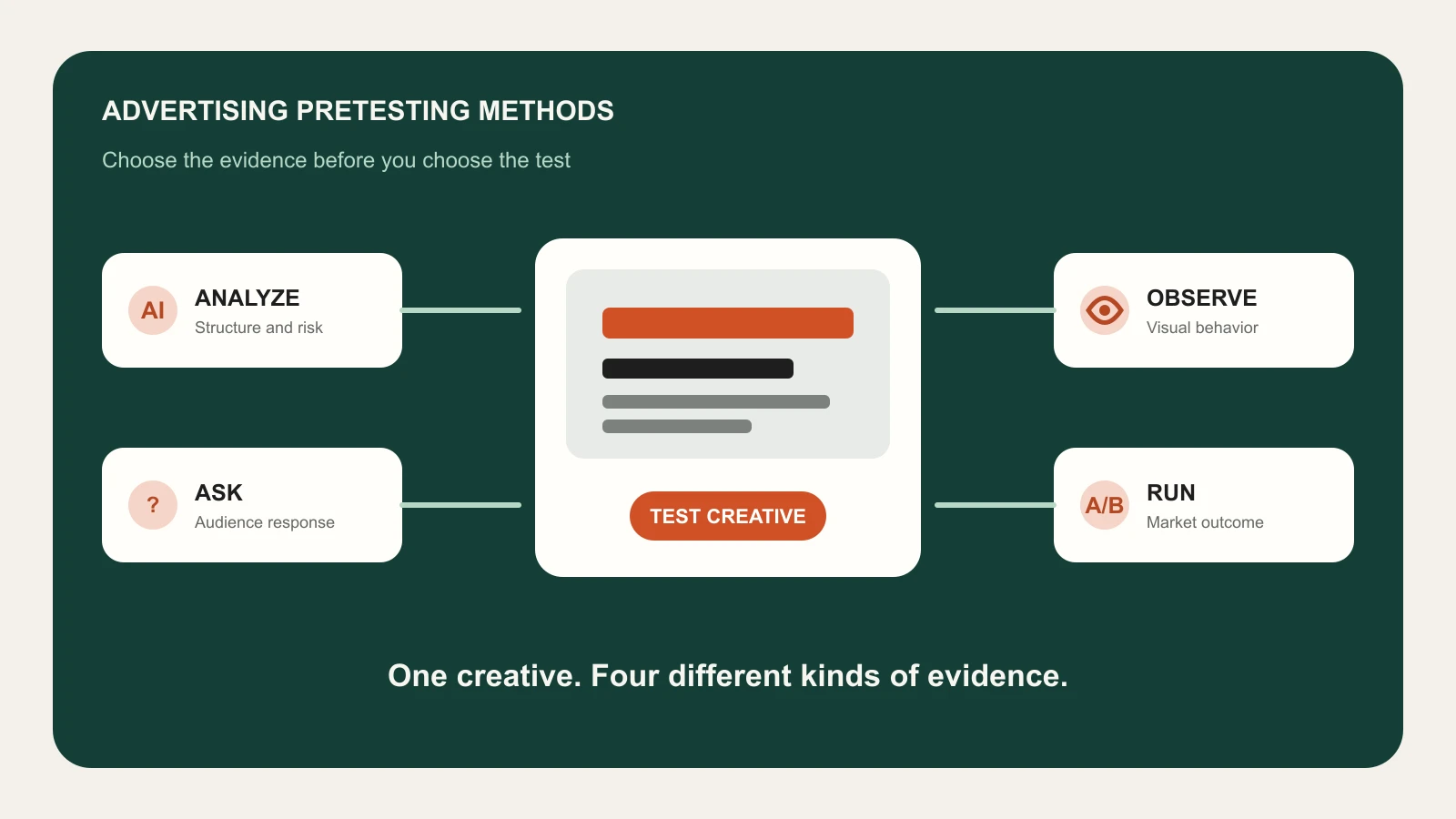
What is advertising pretesting?
Advertising pretesting evaluates creative before a full campaign launch. It can happen when the work is a storyboard, a rough layout, a near-final execution or a finished asset awaiting media investment. The purpose is to reduce a defined uncertainty while there is still time to act.
Classic copy-testing guidance treats method choice as part of the research design. The PACT principles summarized by Pechmann and Andrews recommend measurements relevant to the advertising objective, agreement about how results will be used, multiple measures, a model of human response, realistic exposure and clear definitions of the sample, reliability and validity.
That remains useful in an AI-enabled workflow. A faster tool does not remove the need to define the objective, context, comparison and decision rule. It makes disciplined iteration more affordable.
Start with the decision the evidence must support
“Will this ad work?” combines several questions that require different forms of evidence. Rewrite it as a decision:
- Execution: Is the message readable and visually prioritized in the intended placement?
- Understanding: Does the intended audience understand the offer and connect it to the brand?
- Attention: Do viewers look at the product, brand and call to action in a useful sequence?
- Response: Does the creative change recall, consideration, choice or another audience measure?
- Outcome: Does one version cause a better result under controlled campaign delivery?
State the decision before choosing the metric. “Select one of three concepts for production” is actionable. “Get an engagement score” is not, unless the team has already decided what score or difference would change the selection.
This decision-first approach is also the foundation of our guide to evaluating an ad before spending media budget.
Advertising pretesting methods compared
| Method | Evidence produced | Best question | Typical stage | Main limitation |
|---|---|---|---|---|
| AI or structured creative analysis | Predictions, scores, diagnosed risks and recommendations | What should we improve or compare before further research? | Rough concept through final asset | Does not directly observe the intended audience |
| Consumer survey | Stated response, comprehension, recall, associations and intent | What does the audience understand, remember or report feeling? | Developing through finished creative | Stated response is not the same as behavior or incremental effect |
| Eye tracking | Observed gaze, fixations, sequence and attention to defined areas | Are important elements discovered and viewed? | Near-final or finished creative | Looking does not establish understanding or persuasion |
| Live A/B test | Difference in a campaign outcome under randomized or controlled delivery | Which version produces the better defined outcome in market? | Finished creative in limited live delivery | May identify a winner without explaining why |
The methods form an evidence ladder, not a ranking. A fast diagnosis can prevent obvious execution waste. Human research can test response more directly. A live experiment can validate a finished hypothesis under delivery. Greater realism usually costs more time and makes revision harder.
1. AI analysis: diagnose widely and revise early
AI creative analysis reviews an asset against learned patterns, research-informed criteria or both. Depending on the system, it may predict attention, score creative qualities, compare versions, apply benchmarks or recommend changes.
The method is particularly useful early because it can examine many assets consistently before production and media costs become fixed. Optiks.ai, for example, analyzes eleven connected domains including attention, hierarchy, readability, cognitive load, message, emotion, brand, color, composition, persuasion and context fit. Its output is designed to form revision hypotheses, not to claim that a recruited audience has been observed.
Structured analysis has empirical precedent beyond current generative systems. Armstrong and colleagues compared evidence-based persuasion-principle predictions with copy testing and expert judgment for selected advertisement pairs. The structured method performed better in that particular study. The test concerned high-involvement utilitarian products and used day-after recall as its performance proxy, so the result supports disciplined principles under stated conditions rather than a universal replacement for audience research.
Use AI analysis when:
- You need rapid feedback across many executions or formats.
- The team can still make meaningful changes.
- You need a consistent rubric and prioritized recommendations.
- The decision concerns execution risk, context or the relationship among elements.
Do not claim:
That an AI score is observed gaze, consumer recall, purchase intent or incremental sales. It is a prediction or structured diagnosis unless the method explicitly includes new human or market data.
2. Consumer surveys: ask the audience about meaning and response
Consumer pretests expose recruited participants to creative and collect measures such as comprehension, recall, brand attribution, associations, emotion, consideration or purchase intent. They are useful when the decision depends on what people understand, remember or report.
A monadic design shows each participant one test condition. This reduces direct comparison effects and is useful when the creative should be judged as it would appear alone. A comparative or sequential design shows multiple versions, which can be efficient for preference and diagnostic work but can encourage participants to notice differences they would miss naturally.
Sample relevance matters more than raw size alone. The participants should resemble the audience required by the decision, and the exposure should approximate the channel. Kantar’s current LINK+ materials, for example, describe mobile survey testing across rough and finished formats with country and category norms. The provider’s sample and method are useful context; the advertiser still needs to check that the market, audience and test conditions fit the campaign.
Use surveys when:
- You need evidence about comprehension, brand linkage, recall, associations or reported intent.
- The launch is important enough to justify a relevant human sample.
- You need diagnostic follow-up questions after exposure.
- Stakeholders require audience evidence rather than an expert or model judgment.
Do not claim:
That reported preference or intent guarantees behavior. Questionnaire wording, artificial attention, memory prompts and the gap between intention and action can all affect interpretation.
3. Eye tracking: observe visual behavior
Eye tracking records where participants look, when they look and how gaze moves through an execution. Depending on the design, it can use laboratory hardware, wearable equipment or remote webcam estimation.
The method is well suited to visual-discovery questions. It can test whether the brand receives a fixation, how quickly a price is found, whether a call to action is skipped and whether the viewing sequence follows the intended hierarchy. Research by Wedel, Pieters and Liechty shows that viewing goals can change the time course of eye movements across advertisements, which is why task and exposure instructions must be reported rather than treated as neutral details.
Attention is not a complete effectiveness measure. A long fixation may reflect interest, effort or confusion. Salient advertising can draw attention while interrupting another task, and gaze toward a face or cue can redirect attention without proving comprehension or persuasion. Pair gaze measures with a task, recall question, interview or survey when the decision extends beyond visibility.
For study formats, sample design and common interpretation mistakes, see eye tracking in advertising.
Use eye tracking when:
- The order and discovery of visual elements are material to the decision.
- You need observed behavior rather than a predicted heatmap.
- The placement, distance or screen context can be reproduced credibly.
- You can define areas of interest before analyzing the data.
4. Live A/B tests: validate a finished hypothesis
A live A/B test divides eligible delivery between conditions and compares a predefined outcome. Strictly speaking, this is in-market validation rather than a laboratory pretest. It belongs here because teams often use a limited experiment before committing the full budget or rollout.
A clean creative experiment changes the creative while keeping audience, objective, bid strategy, placement and measurement as comparable as possible. Google’s guidance for basic two-arm video experiments recommends using the same audience and varying the creative. Display & Video 360 similarly describes mutually exclusive groups for controlled testing.
The metric should follow the hypothesis. A visibility change may affect view rate or completion. A clearer offer may affect qualified clicks or conversion. A stronger brand cue may require a brand-lift measure rather than click-through rate. Choose one primary outcome before seeing the result and define the minimum difference worth acting on.
Live experiments require enough time, budget and eligible traffic. Google notes that some experiments may need four to six weeks. A small inconclusive test is not proof that two ads are equal; it may mean the experiment could not detect the difference.
Use live A/B tests when:
- The creative is finished and can be delivered under controlled conditions.
- The account has enough volume to detect a meaningful outcome.
- You can keep noncreative variables stable.
- You have predefined the primary metric, duration and decision rule.
Do not claim:
That a winning asset reveals the psychological mechanism. Use diagnostic evidence to explain why the result may have occurred, then test the next specific hypothesis.
Seven rules for a valid advertising pretest
- Define the objective. Awareness, brand attribution, offer comprehension and conversion require different measures.
- Define the use of the result. Decide whether the evidence will select, revise, stop or escalate a concept.
- Match the sample or comparison set. A broad norm can provide context but should not be labeled a precise category benchmark.
- Match the exposure. Test a billboard at plausible scale and viewing time; test a feed asset in a feed-like environment.
- Match the finish. Do not compare a polished execution with a rough sketch unless finish itself is part of the decision.
- Use more than one measure when the response model requires it. Attention, memory and action are connected but not interchangeable.
- Predefine the decision rule. Agree what difference matters before the results are known.
These rules prevent a polished dashboard from concealing a weak research design. They also help teams distinguish a useful directional screen from evidence strong enough to approve a major launch.
A practical testing sequence
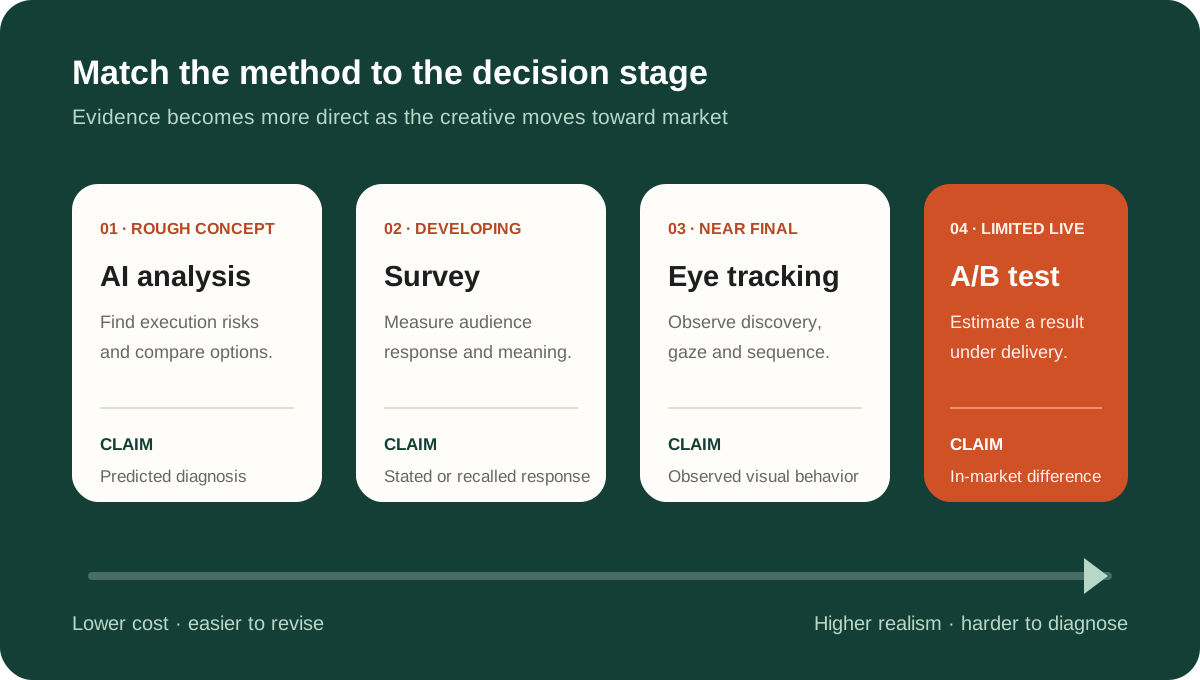
- Screen rough concepts. Use structured or AI analysis to identify execution risks and decide which concepts deserve development.
- Test audience meaning. Use a monadic survey when comprehension, brand attribution, associations or intent could change the selection.
- Observe the critical behavior. Add eye tracking when discovery, visual order or viewing conditions remain uncertain.
- Run a limited live experiment. Change one important creative variable and test a predefined market outcome.
- Record the learning. Connect the result to the original hypothesis so it improves later briefs, benchmarks and analysis.
This is a sequence, not a requirement to use every method. A low-risk social variation may need only structured review and a live platform test. A national campaign with a new proposition may justify all four layers.
A practical advertising pretesting brief
Before commissioning a tool or study, complete this one-page brief:
- Decision: What action will the result determine?
- Hypothesis: What creative change is expected to affect which response?
- Objective: What is the campaign intended to achieve?
- Stage: Rough concept, developing execution, finished asset or limited live delivery?
- Audience: Whose response matters, and what exclusions apply?
- Context: Channel, format, placement, distance, device, duration and competing content?
- Conditions: Which versions will be compared, and what will remain constant?
- Primary measure: What single result will decide the outcome?
- Secondary measures: What will help explain the result?
- Decision rule: What difference is large and reliable enough to act on?
- Limitations: What can this method not establish?
For teams comparing several concepts before production, Optiks.ai concept comparison provides a structured starting point. Use the brief to decide whether the result also needs human or in-market validation.
Frequently asked questions
What is advertising pretesting?
Advertising pretesting evaluates creative before a full campaign launch. It may examine execution, audience response, observed attention or a limited live outcome, depending on the decision.
Which advertising pretesting method is best?
There is no universal best method. AI analysis supports fast diagnosis and iteration. Surveys measure audience response. Eye tracking observes visual behavior. Controlled A/B tests estimate in-market differences. Choose according to the claim you need to make.
Is an A/B test a pretest?
A live A/B test is technically in-market validation. It can still be the final stage of a practical pretesting program when the team limits delivery, compares controlled conditions and uses the result before full rollout.
Can AI replace consumer surveys or eye tracking?
No. AI can provide fast predictions and structured diagnosis, but it does not directly observe a newly recruited audience. Use human research when the decision requires evidence of gaze, comprehension, recall, feeling or intent.
Should a pretest compare multiple ads?
It can, but the design changes the interpretation. Monadic testing reduces direct comparison effects. Comparative testing can efficiently reveal preferences and differences, but may focus attention on details that natural exposure would not.
Sources and methodology
This guide distinguishes model output, stated response, observed behavior and in-market outcome. Provider materials are used only to describe current methods. Research findings are reported with their conditions and should not be generalized beyond the underlying design. Sources were checked on 3 November 2026.
- Pechmann, C. & Andrews, J. C. (2010). Copy test methods to pretest advertisements. Review of copy-testing stages, methods and PACT principles.
- Armstrong, J. S., Du, R., Green, K. C. & Graefe, A. (2016). Predictive validity of evidence-based persuasion principles. European Journal of Marketing, 50(1/2), 276–293.
- Wedel, M., Pieters, R. & Liechty, J. (2008). Attention switching during scene perception: how goals influence the time course of eye movements across advertisements. Journal of Experimental Psychology: Applied, 14(2), 129–138.
- Simola, J., Kuisma, J., Öörni, A., Uusitalo, L. & Hyönä, J. (2011). The impact of salient advertisements on reading and attention on web pages. Journal of Experimental Psychology: Applied, 17(2), 174–190.
- Palcu, J., Sudkamp, J. & Florack, A. (2017). Judgments at gaze value: gaze cuing in banner advertisements. Frontiers in Psychology, 8, 881.
- Rosengren, S., Eisend, M., Koslow, S. & Dahlen, M. (2020). A meta-analysis of when and how advertising creativity works. Journal of Marketing, 84(6), 39–56.
- Kantar Marketplace. Agile solutions playbook. Provider description of LINK+ formats, monadic survey method and norms.
- Google Ads Help. Create a video experiment. Guidance on creative as the test variable in a basic two-arm experiment.
- Google Ads Help. About experiments. Experiment types, duration and implementation guidance.
- Google Display & Video 360 Help. About experiments. Mutually exclusive campaign groups and test variables.
Choose the method by the claim. Diagnose with prediction, measure meaning with surveys, observe gaze with eye tracking and validate finished hypotheses with controlled delivery.