AI creative analysis vs. consumer testing: what each can tell you
AI creative analysis examines an advertisement and generates assessments or predictions from a model, its inputs and its evaluation method. Consumer testing collects responses from people exposed to the work. Use AI analysis to identify possible execution problems and develop testable hypotheses; use consumer research to investigate understanding, relevance and response among a defined audience. Neither, on its own, proves that an ad will increase sales.
A campaign can look beautifully resolved and still leave people unsure what it is selling. It can also break a familiar design rule and work because the audience recognizes a reference, understands the joke or already knows the brand.
That is why the choice between AI creative analysis and consumer testing deserves more thought than “Which is faster?” The useful question is: What do we need to know before we commit, and what evidence would answer it?
A tool that spots an unreadable product descriptor can save an expensive research round. A conversation with a customer can reveal that the descriptor is perfectly readable but means something different to them. Both findings matter. They lead to different changes.
This guide explains the differences, the limits of each approach and a practical way to combine them. The campaign examples are illustrative; they are not reports of measured results.

Two ways to investigate the same creative: inspect its execution and learn how people interpret it. Editorial illustration of a research setting.
What is AI creative analysis?
AI creative analysis is the use of machine learning or generative AI to assess advertising assets. Depending on the system, it may examine images, copy, video, layout, supplied brand guidelines and campaign context. Its outputs might include observations, scores, predicted attention, suggested revisions or explanations linked to research principles.
The label covers several different activities:
- Diagnostic review: identifying possible issues with hierarchy, readability, branding, message or suitability for a placement.
- Predictive modeling: estimating an outcome, such as a particular attention measure, using a model trained or calibrated against relevant observations.
- Synthetic audience simulation: generating answers or reactions intended to resemble those of a specified audience.
- AI-assisted research analysis: organizing or interpreting data collected from actual participants, such as interview transcripts or open-ended survey responses.
These are not interchangeable. A generated explanation of an ad is not a record of someone seeing it. A prediction trained against eye-tracking data is not eye tracking of the particular asset being reviewed. Conversely, an interview remains research with a person even if AI helps organize the transcript.
Before judging a platform’s output, establish which activity it performs and what data support its claims.
What is consumer testing?
Consumer testing exposes people to a product, proposition or piece of creative and collects evidence about their response. For advertising, this might involve interviews, surveys, comprehension tasks, recall measures, eye tracking, simulated shopping or experiments in a live environment.
The method determines what you can conclude. An interview can uncover an unexpected interpretation. A survey with an appropriate sample can estimate how common a response is within the limits of its design. A controlled experiment can investigate the effect of exposure on a specified outcome.
“Tested with consumers” is therefore an incomplete description. Who participated? What did they see? How long did they see it? What were they asked? Was the comparison fair? These details are part of the finding, not administrative footnotes.
AI creative analysis vs. consumer testing: a practical comparison
| Question | AI creative analysis | Consumer testing |
|---|---|---|
| What is the evidence? | Model output based on the creative, inputs and evaluation method; sometimes calibrated against human data. | Responses or behaviors collected from people under stated conditions. |
| What can it help uncover? | Possible execution weaknesses, inconsistencies and hypotheses worth investigating. | What participants notice, understand, remember, feel or do, depending on the method. |
| Can it tell us where people look? | Some tools predict attention. The prediction needs validation for the relevant task and format. | Eye tracking records gaze during the study. Gaze alone does not establish comprehension or persuasion. |
| Can it assess cultural meaning? | It may flag possible interpretations, with coverage depending on model knowledge and supplied context. | Research with the intended audience can reveal language, associations and interpretations the team missed. |
| Can it compare revisions? | Yes, provided inputs and evaluation conditions are kept consistent; small score differences may be unstable. | Yes, with a suitable comparison design, sample and outcome measure. |
| What does speed depend on? | Asset complexity, processing, review and the time needed to check recommendations. | Recruitment, study design, fieldwork and analysis. Some methods are rapid; others require substantial planning. |
| Does it prove sales impact? | An unvalidated creative score does not establish sales impact. | Stated intent does not establish sales impact. A suitable field experiment can estimate incremental effects. |
The comparison is about the source and quality of evidence. AI may be involved in both columns. What matters is whether a claim comes from a model, a person’s response or an observed outcome.
What AI analysis is useful for before research begins
Finding execution problems while they are inexpensive to fix
Consider a mobile ad in which the product photograph is strong but the offer becomes unreadable at delivery size. There is little value in discovering that basic problem only after recruitment and fieldwork have begun.
A structured analysis can prompt the team to inspect the crop, contrast, product descriptor, brand prominence and next step. The team can then check those observations against the actual asset. Does the text disappear on a phone? Is the logo obscured by a placement overlay? Are two headlines competing for attention?
The value comes from the specificity of the diagnosis. “Improve engagement” is not an actionable finding. “The offer sits below the likely crop boundary in this placement” can be checked and corrected.
Turning broad doubts into research questions
Creative reviews often begin with an uneasy feeling: the work is too busy, too quiet, too clever or too generic. AI analysis can help turn those reactions into hypotheses.
For example: “The image may imply a premium fragrance, but the copy does not make clear that this is an everyday body spray.” That suggests a useful consumer question: “What kind of product do you think this is?” It also suggests a design intervention: make the category descriptor more prominent without sacrificing the atmosphere.
A hypothesis becomes more useful when it names the uncertain interpretation and the evidence that could challenge it.
Reviewing variations consistently
Campaigns rarely consist of one finished poster. They involve formats, markets, crops, durations and retailer requirements. An analysis framework can help teams review those variations against the same brief and supplied rules.
Consistency still needs managing. Keep the objective, target audience, placement and brand inputs stable when comparing executions. Save the original assets and reports. If the model or scoring method changes, record that too. Otherwise a changed score may reflect changed evaluation conditions rather than changed creative.
Where AI analysis needs a firmer evidence base
A confident explanation is easy to mistake for a validated prediction. They are different deliverables.
If a tool says an ad will be remembered, ask what “remembered” means: unaided brand recall, recognition from a list, recall of the story, or recall after a delay? Ask whether the model was evaluated against that same measure using creative it had not already encountered.
A useful validation discussion covers:
- The target outcome. What precisely is being predicted or scored?
- The relevant population and format. Does the validation include audiences, languages and placements like yours?
- Independent evaluation. Was performance checked on data separate from model development, with precautions against overlap?
- A meaningful baseline. Does the model improve on a simpler rule, a category average or an existing review process?
- Uncertainty and failures. How variable are the results, and where does performance weaken?
These are procurement and interpretation questions. An attractive dashboard does not answer them.
An overall score can help organize a review, but a score of 80 is not automatically an 80% chance of success, a percentile rank or a sales forecast. The scale needs an explicit definition. A benchmark also needs an identifiable reference group; an average of unrelated assets is not necessarily useful for your campaign.
What people can reveal that a creative review may miss
The meaning they actually take away
The creative team knows the brief. The audience sees the ad.
An intended message about flexibility might be interpreted as an absence of commitment. A photograph meant to signal craftsmanship might suggest an old-fashioned product. Research can reveal those interpretations without requiring the team to anticipate them first.
Ask for an account in the participant’s own words before explaining the concept. Once the moderator has supplied the intended meaning, the study is answering a different question.
The difference between understanding and caring
Someone can understand an offer and have no use for it. They may already own a suitable alternative, distrust the claim or consider the benefit irrelevant to their circumstances.
A clearer headline might fix comprehension while leaving the proposition unchanged. Interviews and well-designed questions can help distinguish an execution problem from a weak reason to choose the product. That distinction prevents endless polishing of an offer the audience does not want.
Context that the brief left out
Category experience matters. A first-time buyer may need reassurance that a regular buyer finds obvious. A familiar visual cue in one market may be confusing in another. A retailer’s environment may make a subtle pack design disappear among stronger competitors.
Recruit around the question you need to answer. If the issue concerns new category buyers, feedback from loyal customers alone is unlikely to settle it. If the creative depends on local humor, include people familiar with the relevant language and context.
Consumer testing has limits too
People are real; the testing situation may still be artificial.
A participant asked to study an ad for a minute has received a different exposure from someone passing a bus shelter. Seeing several concepts side by side encourages comparison; seeing one concept alone investigates a different experience. A group discussion may be useful for exploring language, while also allowing confident participants to influence the conversation.
Question design matters. Pew Research Center documents how wording, response options and question order can change answers. Its guidance is a useful reminder to ask clear questions and avoid supplying an interpretation before measuring it. Source: Pew Research Center, “Writing Survey Questions.”
For an advertising study, “How clearly does this ad communicate the convenience of delivery?” has already named the intended benefit. “What do you think this ad is offering?” leaves room for a different answer. Use the latter when unaided understanding is the question.
Keep these distinctions visible in the report:
- Liking is a response, not a complete effectiveness measure. An enjoyable execution can leave the brand behind.
- Purchase intention is a stated intention. It should not be presented as recorded purchasing.
- Recognition and recall are different tasks. Prompting someone with a logo is not the same as asking them to name the brand unaided.
- A qualitative pattern is not a population percentage. Interviews can expose a problem without establishing how widespread it is.
- A larger sample does not repair the wrong question. Precision is only useful when the study measures the decision that matters.
Does neuroscience remove those limitations?
Neuroscience and behavioral measures can add evidence beyond direct questioning. Nielsen’s overview describes combining EEG, biometrics, facial coding and eye tracking, while acknowledging limitations in individual techniques and the importance of viewing context. Source: Nielsen, “Consumer Neuroscience Goes Mainstream.”
Treat each measure according to what it captures. Looking at an element does not establish that its message was understood. A physiological response still needs interpretation. And an AI-generated attention map should be labeled as a prediction, rather than presented as a recording from participants.
The useful approach is to combine measures that answer complementary questions. Adding a scientific-looking output does not make an unsuitable study design suitable.
Can synthetic audiences replace consumer testing?
Synthetic audiences are model-generated respondents or simulations. They may be useful for exploring possible reactions, drafting questions or stress-testing assumptions. Their answers do not become observations from real consumers simply because the prompt describes a demographic group.
There is published research exploring this possibility. Brand, Israeli and Ngwe’s Using GPT for Market Research investigated using generated responses to study consumer preferences. It provides a basis for investigation, not blanket validation of every synthetic panel, model or advertising task. Source: Marketing Science Institute, research summary.
Ipsos also examined LLMs for conjoint and MaxDiff research, comparing generated responses with human data. Its work is relevant because it evaluates a defined research task rather than treating plausible language as sufficient evidence. Results from a particular model and choice task should not be assumed to transfer to an unrelated campaign or later model. Source: Ipsos, “The Viability of Large Language Models for Conjoint and MaxDiff Analysis.”
If a supplier offers synthetic testing, ask how it is grounded in real audience data, which decisions have been validated and when fresh human research is still required. Increasing the number of generated answers does not create an equivalent number of independently recruited people.
A worked example: one ad, three different questions
Imagine a fictional skincare brand, Luma, preparing a mobile campaign for an everyday moisturizer. The ad uses a pale bottle, a soft background, the headline “Make room for calm” and a small “Explore the collection” call to action.
The objective is to encourage new customers to visit the product page. The team is uncertain whether the work communicates the product clearly enough.
1. AI-assisted diagnosis: is the execution carrying the message?
A review flags three possible issues: the product category is hard to identify, the descriptor loses contrast at mobile size and the next step sounds like a general brand invitation.
Those findings suggest a revision: retain the mood, increase the descriptor’s contrast and test a more explicit destination such as “Explore the daily moisturizer.” The findings do not establish whether the audience values the product’s promise.
2. Consumer research: what do people understand and find relevant?
Expose suitable category buyers to the creative under a defined mobile-viewing task. Ask what the product is, what benefit they take from it and what they expect after tapping. Explore unfamiliar or ambiguous language without first explaining what the team intended.
Suppose participants interpret “calm” as a claim about sensitive skin rather than the brand’s intended description of a simple daily routine. That hypothetical finding raises a proposition question. Making the headline larger would not resolve it; the promise itself needs attention.
3. An in-market experiment: does the revision change behavior?
Once the promise and execution are settled, a properly configured experiment can compare the original and revised ads against the agreed outcome. Keep other important conditions comparable and decide beforehand what would count as a useful difference.
If the outcome is product-page visits, the experiment addresses visits. It does not by itself establish profitable customer acquisition. If several elements change together, it evaluates the package of changes rather than proving which individual edit caused the result.
The sequence avoids asking one method to answer all three questions.
How to combine AI analysis and consumer testing
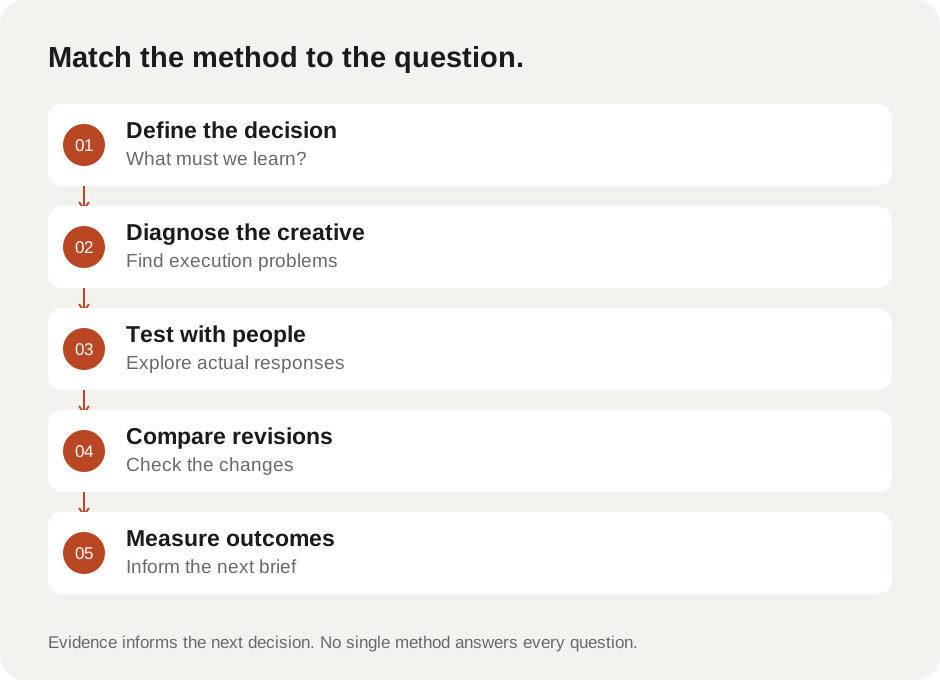
Start with the decision. Use each method to resolve a specific uncertainty, then bring the evidence into the next brief.
Step 1: Write down the decision and the cost of being wrong
Are you correcting a format adaptation, choosing a proposition, entering a new market or committing a major production budget? State the decision before selecting the tool. A small execution change and an unfamiliar positioning strategy do not require identical evidence.
Step 2: Inspect the creative against the brief
Use AI analysis and professional review to find observable execution issues. Check recommendations in the actual format, with the supplied brand rules and placement requirements. Separate corrections from hypotheses: “The required descriptor is missing” is different from “This image may feel impersonal.”
Step 3: Test the uncertainty that remains
Choose participants and methods around the unresolved question. Use exploratory research when you need to understand interpretation. Use an appropriate quantitative design when the decision depends on estimating differences or prevalence. Plan sample size around the measure, expected variability and difference worth detecting; there is no universal participant count that makes an ad “validated.”
Step 4: Revise without losing the idea
Build a change list that connects evidence to an action. Preserve distinctive elements unless the evidence gives a reason to change them. Retest material changes when the original finding may no longer apply.
If AI analysis and consumer findings disagree, investigate the disagreement. A model may be rewarding visual simplicity while participants rely on a familiar category cue that looks like clutter. Equally, positive comments may coexist with poor unaided brand recall. Resolve the relevant question rather than averaging unrelated scores.
Step 5: Record outcomes with their conditions
Save the version that ran, objective, audience, placement, timing and results. When the decision requires causal evidence, use an appropriate experimental approach where feasible.
Google’s research on brand-lift surveys describes randomized experiments and the complications introduced by response bias and imperfect exposure. Its work on geo experiments describes assigning geographic areas to treatment and control conditions. These approaches address effects of advertising exposure; a pre-launch diagnostic score serves a different purpose. Sources: “Methods for Measuring Brand Lift of Online Ads” and “Measuring Ad Effectiveness Using Geo Experiments.”
Keep the distinction between recording outcomes and proving causation. A sales increase after launch could also reflect distribution, price, seasonality or other activity. Logged results are useful learning material, but they do not automatically validate every recommendation in the original report.
Which method should you use for your next campaign?
| Your main uncertainty | A useful starting point | What to check next |
|---|---|---|
| Is the ad readable and coherent at delivery size? | Structured creative review, supported by AI analysis. | Inspect the real crop, device size and viewing conditions. |
| Do people understand the intended product and offer? | Comprehension research with relevant participants. | Collect unaided responses before explaining the message. |
| Does the proposition feel relevant or credible? | Audience interviews or a suitably designed concept study. | Distinguish confusion from disbelief or lack of interest. |
| Will this cultural reference work in a new market? | Local audience research and knowledgeable local review. | Check language, associations and unintended interpretations. |
| Which revision improves a defined response? | A controlled comparison suited to that response. | Keep exposure conditions comparable and report uncertainty. |
| Did advertising cause additional business outcomes? | An appropriately designed incrementality experiment. | Check power, implementation, measurement window and alternative explanations. |
When resources are limited, prioritize the assumption that could most seriously undermine the campaign. A brand entering an unfamiliar category may learn more from resolving proposition ambiguity than from another round of color preferences. A proven campaign being adapted to a new format may mainly need careful execution checks.
Where Optiks.ai fits
Optiks.ai is designed to support structured creative review: an Effectiveness Score, a Creative Fingerprint across 11 domains and recommendations that can become a prioritized action list for the team or agency.
Those domains are Attention, Hierarchy, Readability, Cognitive Load, Message, Emotion, Brand, Color, Composition, Persuasion and Context Fit. They provide a way to inspect how an execution is working and decide what to investigate or improve.
Use the report as an input to judgment. A domain labeled “Emotion” is an assessment within the tool’s framework, not a claim that the target audience’s emotions have been directly measured. An improved score after revision should be interpreted within the scoring method, rather than translated into an unsupported sales uplift.
For a practical walkthrough of the review itself, see How to evaluate advertising creative before launch: an 11-domain checklist.
Frequently asked questions
Can AI replace focus groups?
AI can help prepare research, identify hypotheses and analyze material collected from participants. Generated reactions are not equivalent to a focus group with real people. Whether a focus group is the right alternative depends on the question; interviews, surveys or behavioral tasks may be more suitable.
Is an AI attention heatmap the same as eye tracking?
No. A predictive map estimates attention using a model. Eye tracking records gaze from participants during a task. Ask how any prediction has been validated and avoid treating either measure as a direct reading of understanding or purchase motivation.
Is AI creative analysis cheaper than consumer testing?
An automated review may have a lower marginal cost than a newly commissioned study, especially across many variations. Costs vary by supplier, scope and method. Compare the cost of resolving the relevant uncertainty, including the consequences of making a decision on insufficient evidence.
Does a high creative score mean the ad will sell?
Not by itself. The score’s meaning depends on its definition and validation. Sales also depend on the offer, price, availability, audience, media delivery and other conditions. A diagnostic score should not be presented as a probability of purchase or a guaranteed return.
Should AI analysis come before consumer research?
Often it is useful for removing basic execution problems before testing. But early consumer research may need to come first when the audience, problem or proposition is poorly understood. The order follows the uncertainty, not a fixed rule about technology.
Build the evidence the decision needs
Good creative review makes it easier to say what needs attention and why. Good consumer research exposes the work to interpretations the team cannot supply for itself. Good measurement then checks what happened under stated conditions.
Use AI analysis to make the work and the questions sharper. Use people to investigate how the work lands. Keep the results connected to the version that actually ran. That gives the next brief something more useful than another opinion about the last campaign.
Sources and research notes
This is a practical synthesis of research methods and creative-review practice, not an original validation study. The examples and recommended workflow are illustrative. Supplier research is identified below; none of these sources independently validates Optiks.ai or guarantees an individual campaign’s performance.
- Pew Research Center: Writing Survey Questions. Guidance on wording, response options and question order.
- Smith and Marci, Nielsen (2016): From Theory To Common Practice: Consumer Neuroscience Goes Mainstream. A research supplier’s discussion of complementary measurement methods and their limitations.
- Brand, Israeli and Ngwe: Using GPT for Market Research. Marketing Science Institute research summary of exploratory work with generated consumer responses.
- Ipsos (2024): The Viability of Large Language Models for Conjoint and MaxDiff Analysis. Supplier research on defined choice tasks, not a universal assessment of synthetic audiences.
- Fan, Hesterberg, Liu and Zhang (2018): Methods for Measuring Brand Lift of Online Ads. Research on survey-based randomized experiments and estimation challenges.
- Vaver and Koehler (2011): Measuring Ad Effectiveness Using Geo Experiments. Research on geographic treatment and control designs.