Creative testing before launch: how to evaluate an ad before spending media budget
Creative testing before launch should answer a decision, not produce a decorative score. Define what the advertisement must communicate, test the real execution in its intended context, use the lightest method that can answer the question, and agree in advance what evidence will lead to launch, revision, retesting or cancellation.
The most expensive time to discover that a headline cannot be read is after the media is booked. The worst time to learn that people remember the image but not the advertiser is after the campaign has reached millions. Pre-launch creative testing exists to find those failures while they can still be fixed.
It also has limits. A small research session cannot recreate every competitive, media and commercial condition. A strong score cannot guarantee sales. The aim is to reduce avoidable uncertainty, compare alternatives fairly and create explicit hypotheses for in-market measurement.

Good creative testing changes the work or strengthens the decision. If no plausible result could affect either, the test has no job.
What is pre-launch creative testing?
Pre-launch creative testing is the structured evaluation of advertising before media deployment. It can inspect a nearly finished asset, compare alternative concepts or examine individual elements such as a headline, offer, image, sequence or call to action.
The phrase covers several methods that answer different questions:
- Execution checks verify format, size, safe zones, contrast, legal copy and technical delivery.
- Structured diagnostics identify likely weaknesses in attention, hierarchy, readability, cognitive load, message, emotion, brand, color, composition, persuasion and context fit.
- Qualitative research explains how people interpret the work and why confusion or resistance occurs.
- Quantitative tests estimate how common a response is or compare concepts on predefined measures.
- Experiments compare outcomes under controlled delivery conditions, usually after the creative enters a real platform or market.
These methods complement one another. An accessibility check can establish that text contrast fails a defined standard, but it cannot estimate purchase intent. An interview can reveal that participants misread the promise, but it cannot show how prevalent that interpretation is in the population. A randomized test can show which version changes an outcome, but without diagnosis it may not explain why.
Start with the decision, not the method
Before recruiting participants or uploading files, write the decision the evidence must support. Examples include:
- Choose one of three concepts for development.
- Decide whether a finished campaign is ready for launch.
- Identify which elements require revision before adaptation.
- Check whether the outdoor version survives a four-second viewing opportunity.
- Determine whether a new offer treatment improves comprehension without weakening brand attribution.
Then write a decision rule. A useful rule names the required performance, critical failure conditions and what happens next. For example: “Launch if at least 80% of target participants identify the brand and core offer without prompting, and no required claim or action is misunderstood by more than 10%. Otherwise revise and retest the failed element.”
The exact thresholds depend on risk, category and method. Their purpose is to prevent the team from redefining success after seeing a favored concept lose.
Write the communication task separately from the business objective. “Increase trial” is a business objective. “Make non-users understand that the starter plan requires no annual contract” is a communication task. Creative testing can examine the second directly; the first needs in-market outcome evidence.
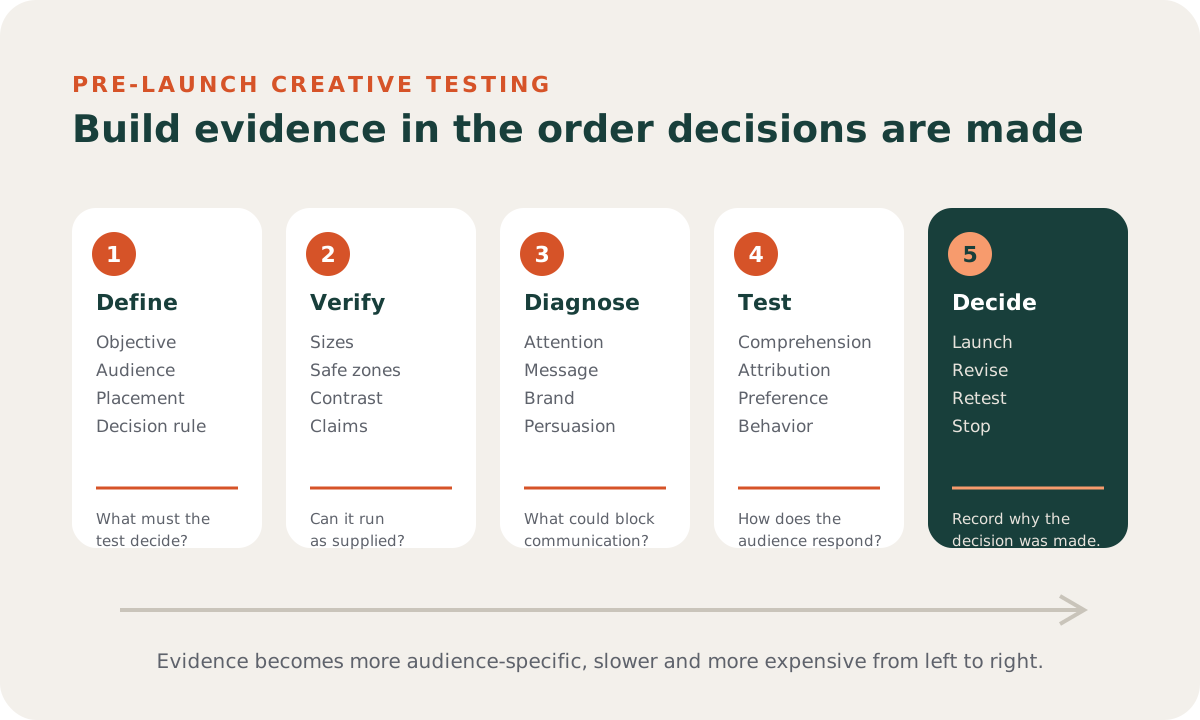
A five-stage pre-launch creative testing system
1. Define the intended response
Specify the audience, objective, placement and viewing conditions. State what a person should notice, understand, remember, feel or do after encountering the ad. Prioritize those responses. A campaign cannot make every element equally prominent.
Include context in the brief. A transit poster viewed while walking, a mobile feed ad and a cinema film create different time, sound and attention conditions. The context fit guide explains why the same asset can work differently across place, moment and medium.
2. Verify the execution
Inspect final files rather than presentation mockups. Render every important size. Check crops, safe zones, subtitles, sound-off behavior, loading, legal requirements, destination URLs and accessibility. Evaluate copy at intended physical size and distance.
For digital text, W3C guidance on minimum contrast provides a useful technical reference. Passing a contrast ratio does not guarantee a headline is noticeable or large enough, but failing one creates an avoidable barrier.
3. Diagnose the creative
A structured review should describe observable evidence and a plausible consequence. “The creative feels weak” is not a diagnosis. “The product name occupies less visual weight than the decorative image and appears after the offer in the scan path, increasing the risk of weak attribution” is testable.
Review the relationships between domains. Increasing contrast may improve readability but pull attention away from the brand. Adding proof may increase persuasion but create cognitive load. A useful diagnosis prioritizes the few changes most likely to improve the assigned communication task.
Optiks.ai provides this layer through a structured AI creative analysis, placement context, action steps and concept versions. The result is a set of hypotheses for revision, not a claim that a score guarantees commercial performance.
4. Gather audience evidence where the risk requires it
Use unprompted exposure first. Show the creative for a realistic period, remove it, then ask what the person saw, who it was from, what it meant and what action it suggested. Ask neutral questions before displaying answer choices. This reduces the risk that the test teaches participants the intended message.
Follow with targeted questions about credibility, relevance, emotion or preference only when those measures relate to the objective. Preference is not a universal winner metric: people may like an ad while misattributing it, or dislike an urgent safety message that communicates correctly.
5. Decide and record the reasoning
End with launch, revise, retest or stop. Record the asset version, method, sample, conditions, results, decision and unresolved risks. Save the exact creative that was evaluated. Without that link, a future note saying “concept B performed best” teaches very little.
The decision record becomes the start of a learning system. Connect it to delivery and outcomes after launch so the next brief can distinguish predictions that held from assumptions that did not. See the broader guide to measuring advertising effectiveness for that full evidence chain.
Choose the lightest method that answers the question
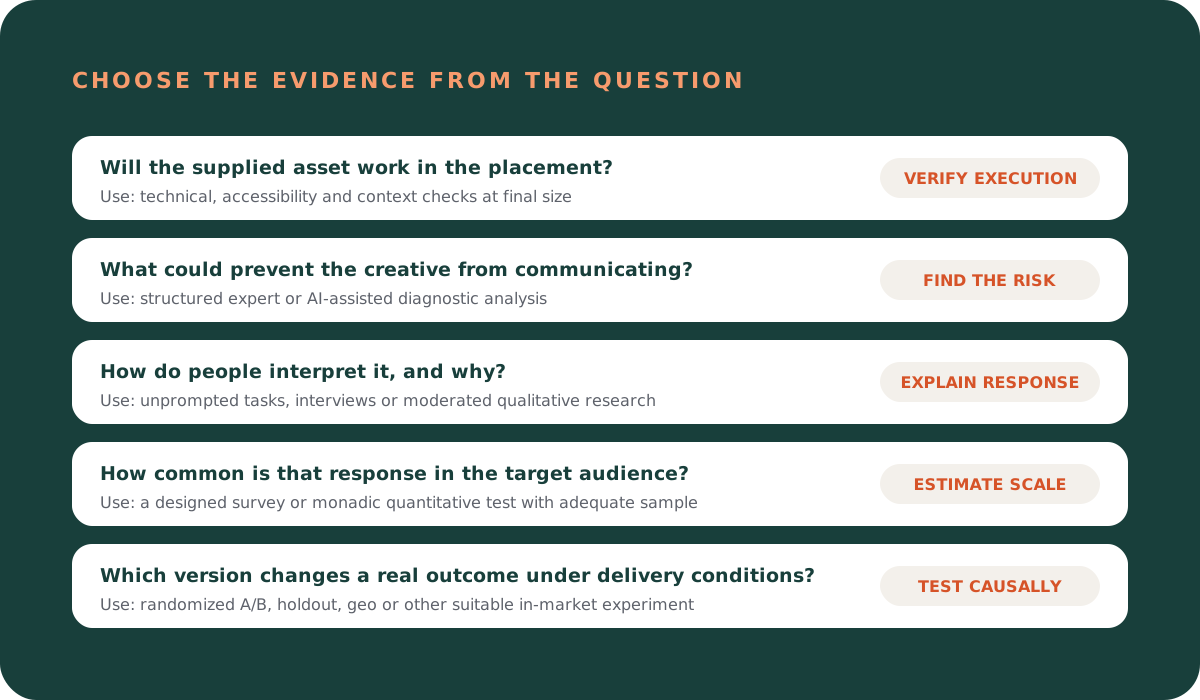
A more expensive method is not automatically better. Method quality means fit between the question, sample, measurement and decision.
Diagnostic analysis
Use structured analysis when you need rapid identification of communication risks across many assets or adaptations. It is useful early, when revisions are cheap, and for quality control across placements. Pair it with audience research when interpretation is uncertain or the decision carries substantial risk.
Qualitative interviews and tasks
Use qualitative work to learn how people decode the ad. Smaller samples can reveal recurring misunderstandings, missing knowledge and unexpected associations. Do not present frequency claims such as “30% of customers will be confused” from a small qualitative sample.
Monadic quantitative testing
In a monadic test, each participant evaluates one concept. This reduces direct comparison effects and resembles real exposure more closely. It needs more sample than showing everyone every concept, but gives cleaner absolute measures of comprehension, attribution and response.
Sequential monadic testing
Participants see several concepts one at a time, with order rotated. This is more sample-efficient, but earlier concepts can influence later judgments. Use it when relative comparison matters and the order effect can be controlled.
Choice and preference tests
Side-by-side preference is fast and easy to understand. It can also reward polish, familiarity or superficial difference. Use it as one measure, not a substitute for whether the creative performs its communication task.
In-market experiments
When the question is which version changes behavior under delivery conditions, use a randomized platform test, holdout or another credible design. Google’s experimentation guidance recommends comparable randomized groups, clean success metrics and avoiding changes while a test is live. This moves beyond pre-launch diagnosis into causal evaluation.
How to design a fair creative comparison
Hold non-tested variables constant
If the goal is to learn whether a clearer offer improves response, keep audience, placement, budget, timing and other creative elements stable. If headline, image, offer and targeting all change, the test compares two packages and cannot identify the cause.
Test the real format
Do not judge mobile creative on a desktop slide or outdoor advertising as a full-screen image. Reproduce likely size, distance, duration, sound and surrounding content. For OOH, inspect both close detail and the intended approach distance. For video, include the first seconds and sound-off state.
Use target-relevant participants
Colleagues know the brief, brand and intended message. Their familiarity removes the ambiguity the test needs to detect. Recruit people who resemble the intended audience and screen for conflicts such as recent involvement in advertising research.
Write measures before collecting data
Choose the primary measure and important failure checks before results arrive. Report absolute values, differences and uncertainty. Avoid searching many segments and declaring whichever movement looks largest to be the result.
Plan sample size from the decision
There is no universal sample size. A qualitative comprehension study needs enough people to expose meaningful patterns; a quantitative comparison needs enough observations to estimate a decision-relevant difference. Sample planning should use the expected base rate, minimum useful difference, desired precision and test design.
Interpret results without overclaiming
Pre-launch findings are conditional: this audience, this exposure, this question wording, this version and this context. State those conditions. A concept that leads on message clarity may not lead on emotional response. A statistically detectable difference may be too small to justify production cost. A large observed difference from a small sample may remain uncertain.
Separate three conclusions:
- Observation: what the evidence directly shows.
- Explanation: why the pattern may have occurred.
- Recommendation: what change or decision follows.
For example: “Only 52% identified the advertiser after four seconds” is an observation. “The brand cue appears late and competes with the offer” is an explanation supported by the execution. “Move the distinctive cue into the first visual cluster and retest attribution” is a recommendation.
The IAB and MRC Attention Measurement Guidelines make a related distinction between attention to a placement and attention to delivered creative. Format, environment and device affect expectations. This is why a universal creative benchmark should not replace a relevant comparison set.
Worked example: testing a fictional subscription campaign
A fictional home-energy service, North Home, has two static concepts for a paid social and display campaign. The business objective is qualified trial. The communication task is to establish that the plan reduces evening energy costs without requiring a long contract.
Define
The team sets three critical measures: unaided understanding of the saving mechanism, correct brand attribution and recognition that there is no annual commitment. It defines a failure condition: a concept will not launch if more than 15% believe the stated saving is guaranteed for every household.
Verify and diagnose
Both concepts pass technical checks. Structured analysis finds that concept A has stronger brand linkage but buries the contract condition. Concept B makes the condition visible but uses a decorative device mockup that draws attention away from the saving mechanism.
Test
Participants see one concept at feed size for a realistic duration. They describe the advertiser and offer without prompts before answering standardized questions. The test reveals that concept A wins on attribution while concept B produces better contract comprehension. Neither passes the team’s full decision rule.
Revise and retest
The team does not average the two scores and choose the least weak concept. It creates a third version using concept A’s brand structure and a shortened condition treatment from concept B. A focused retest confirms improved comprehension without reducing attribution.
Connect to market evidence
The revised version enters a randomized delivery test against the current control. Qualified trials are the primary outcome; message and brand measures remain diagnostics. The pre-launch work reduced known communication risks, while the in-market test determines whether the change improves behavior under campaign conditions.
Common creative testing mistakes
Testing taste instead of the communication task
“Which one do you like?” is easy to ask and often weak evidence. Measure whether the work communicates what the campaign needs to establish.
Explaining the ad before testing it
The audience will not receive the strategy deck. Begin without the brand story, creative rationale or intended takeaway.
Using colleagues as the audience
Internal teams are valuable for feasibility and brand checks. They are poor substitutes for people who do not know the answer.
Showing unrealistic exposure
Unlimited full-screen viewing hides hierarchy, readability and timing failures. Test in context and at size.
Changing too many variables
Radically different concepts may be appropriate at an early selection stage. They are not suitable for learning which specific element caused a difference.
Choosing the winner by total score alone
A composite can conceal a critical failure. A campaign with high visual appeal and low brand attribution may build memory for the category or competitor. Examine the profile and decision rule.
Treating prediction as proof
Pre-launch testing improves the odds of clear communication. It does not hold media, competitors, availability, price or customer experience constant. Validate important recommendations through in-market results.
Frequently asked questions
What is the difference between concept testing and creative testing?
Concept testing evaluates the underlying proposition or creative route, often before final production. Creative testing can include concept work but also examines finished execution, adaptations and specific elements. Be clear whether the decision concerns the idea, the execution or both.
When should creative testing happen?
Use lightweight diagnostics while routes are still flexible, audience research before major production or media commitment, final execution checks on supplied assets, and in-market experiments when the question concerns real behavior. Testing works best as a sequence, not one approval gate.
How many people are needed?
It depends on the method and decision. Qualitative work seeks explanatory patterns; quantitative work estimates prevalence or differences. Plan quantitative sample size rather than relying on a universal number, and report uncertainty with the result.
Should every creative be tested?
Testing effort should reflect spend, novelty, risk, reversibility and learning value. High-cost, high-reach or regulated work deserves more evidence. Repeated adaptations may need automated checks and sampling rather than a full study for every file.
Can AI replace consumer testing?
No single method replaces all others. AI-assisted analysis can rapidly find execution risks and structure hypotheses. Consumer research measures human interpretation and response. Experiments measure differences under delivery conditions. Our guide to AI creative analysis versus consumer testing shows where each fits.
Research and references
- Google: Playbook of marketing experiment principles, methodology and tools
- Google: The Experiments Playbook—Media Effectiveness
- Meta Audience Network: A/B testing and creative variables
- IAB and Media Rating Council: Attention Measurement Guidelines
- W3C: Understanding Success Criterion 1.4.3, Contrast (Minimum)
- Google Research: Methods for Measuring Brand Lift of Online Ads
The worked example is fictional. Research design, statistical interpretation, regulated claims and accessibility decisions should involve appropriately qualified specialists.
Test the decision while the work can still change: define the task, inspect the real execution, diagnose the risk, gather the evidence the risk deserves, and record what happens next.