What makes an advertisement effective? 12 qualities that influence performance
An effective advertisement performs its assigned job for a defined audience under real viewing conditions. It earns enough attention to communicate, makes the advertiser and promise easy to encode, gives people a credible reason to respond, and produces evidence that can improve the next decision.
That definition matters because “effective” is often used as a synonym for attractive, memorable, viral or high scoring. Those can be useful qualities, but none is sufficient by itself. A beautiful ad that is attributed to a competitor is not effective. A high-click ad that produces low-quality customers may not be effective. A moving brand film can be effective without an immediate sale if its job is to build memory and future consideration.
There is no universal creative formula. The best execution depends on the objective, audience, offer, brand, placement and exposure. The useful question is not whether an ad contains every fashionable device. It is whether its parts work together to create the intended response.

Effective creative is a system: attention creates an opportunity, clarity turns that opportunity into meaning, branding gives the memory an owner, and evidence determines whether the intended outcome followed.
What does effective advertising mean?
Advertising effectiveness is the extent to which an advertisement contributes to its intended communication and business outcomes. The phrase covers at least three related layers:
- Execution quality: can people see, read, understand and correctly attribute the creative under realistic conditions?
- Audience response: does exposure influence attention, memory, feeling, belief, consideration or action in the intended direction?
- Business contribution: does the campaign create incremental value after media cost, margin, customer quality and longer-term effects are considered?
A creative review can directly diagnose the first layer and form hypotheses about the second. Audience research can measure interpretation and response. Experiments, matched markets and other causal methods are needed to estimate incremental business impact. Our guide to measuring advertising effectiveness explains how those layers connect.
This distinction prevents two common errors. The first is treating media delivery as proof that the ad worked. An impression records an opportunity for exposure, not attention, comprehension or persuasion. The second is treating a commercial outcome as proof of creative quality. Sales can rise because of price, distribution, seasonality or targeting even when the ad itself is weak.
The 12 qualities form a connected system
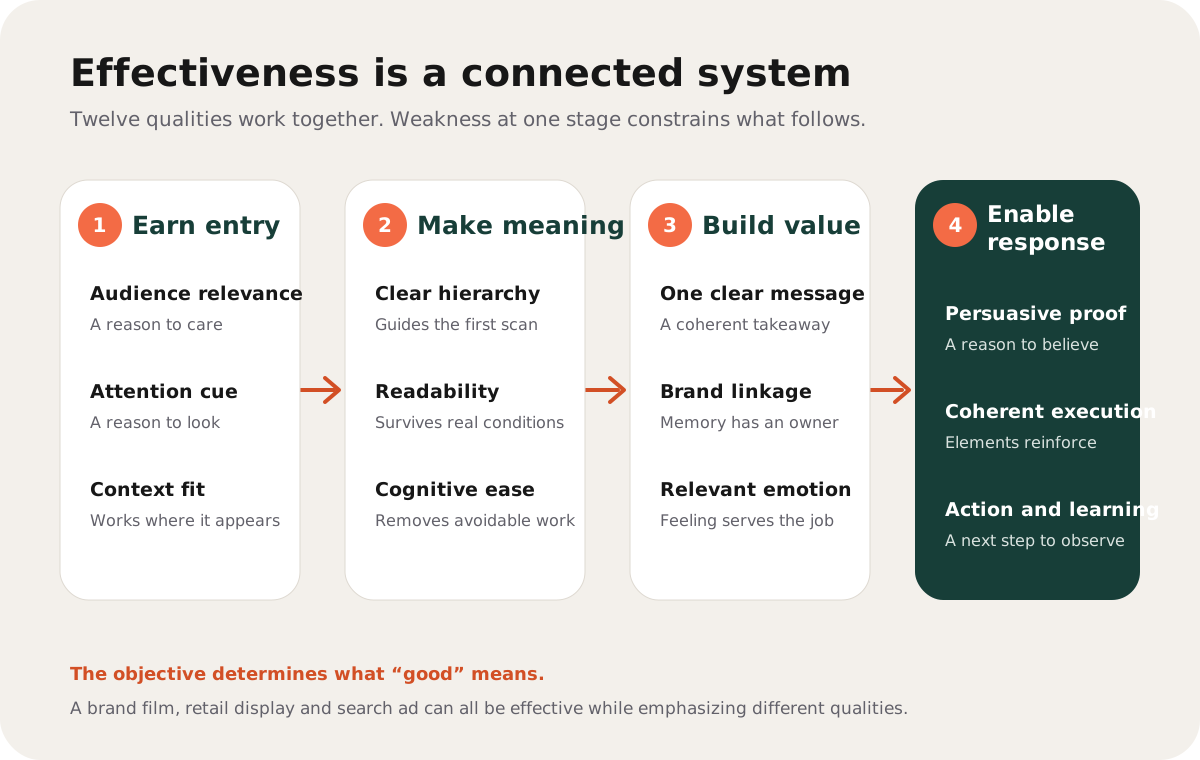
The sequence is not a rigid funnel, but it is a useful diagnostic. If an ad never earns an opportunity to be processed, its message cannot work. If the message is noticed but the advertiser is unclear, memory has no reliable owner. If a promise is understood but lacks credibility or relevance, it may not motivate. If the intended response is undefined, the team cannot judge whether the work succeeded.
The objective determines the weight given to each quality. A retail display may prioritize rapid hierarchy, price comprehension and action. A sponsorship asset may prioritize distinctive brand cues and contextual fit. A safety campaign may accept discomfort if it increases correct understanding. Use the qualities as questions, not as a universal scoring recipe.
The 12 qualities of an effective advertisement
1. A defined job and audience relevance
Effective advertising starts with a specific task: establish a new association, explain a product difference, correct a misconception, make an offer easy to act on, or keep a brand mentally available. “Raise awareness” is usually too vague. Awareness of what, among whom, under which buying situation?
Relevance is the bridge between that task and the audience. It can come from a problem, aspiration, identity, occasion or recognizable tension. Relevance does not require intrusive personalization. It requires the work to connect the brand’s promise with something the intended audience can use or care about.
Diagnostic question: after exposure, can the audience explain why this matters to them and what the advertiser wants to establish?
2. An attention-worthy entry point
Attention creates the opportunity for every later effect, but attention is not the outcome. The IAB attention framework treats attention as a complementary measure that helps connect exposure, engagement and outcomes. It should not be interpreted as a standalone verdict.
An entry point may be a face, motion, contrast, an unresolved question, a distinctive shape, an unexpected juxtaposition or a highly relevant cue. Its job is to interrupt selective attention long enough for the message to begin. Shock and visual noise can attract the eye while damaging trust or obscuring the advertiser.
Evaluate attention in the actual environment. A subtle cue that works in cinema can disappear in a busy feed. A dense poster can command a close-up presentation slide while failing on the street. The deeper attention in advertising guide explains salience, selection and viewing conditions.
3. Clear visual hierarchy
Hierarchy decides what enters the first visual cluster, what follows and what can safely wait. Size, contrast, position, spacing, grouping, movement and visual direction all influence this order. A strong hierarchy does not make everything loud. It assigns emphasis according to the communication task.
Ask what a person can retrieve after one realistic glance. If the product, offer, qualifier and brand all compete at equal strength, the ad has transferred prioritization work to the viewer. When exposure is brief, that work often remains unfinished.
A useful hierarchy joins rather than separates important elements. The promise and brand should be close enough in space or time to form one memory episode. See visual hierarchy in advertising for a practical scan-path analysis.
4. Readability and accessibility
Copy that technically exists but cannot be read in context is not communication. Readability depends on type size, weight, line length, spacing, contrast, background complexity, motion, duration, distance and visual ability. Test supplied assets at the intended size and viewing distance rather than enlarging them on a desktop.
The W3C explanation of minimum text contrast specifies a contrast ratio of 4.5:1 for regular text and 3:1 for large text under WCAG AA. Those thresholds are a valuable accessibility reference, although passing them does not guarantee that type is large enough, prominent enough or displayed long enough.
The readability guide covers typographic reserve, viewing distance and background protection in more detail.
5. Low unnecessary cognitive load
People have limited time and working-memory capacity. Effective advertising uses that capacity on the intended idea instead of avoidable decoding. Familiar conventions, meaningful grouping, concise language and a clear relationship between image and copy reduce unnecessary effort.
Cognitive ease is not the same as blandness. A productive puzzle can create involvement when the audience has time and motivation to resolve it. The problem is effort that contributes nothing to the promise: unexplained symbols, multiple competing claims, decorative charts, contradictory cues or an interaction that hides the action.
When simplifying, protect the information required for an informed decision. The goal is efficient meaning, not minimal content at any cost. Our article on cognitive load in advertising separates useful complexity from friction.
6. One clear message or organizing idea
A strong advertisement can contain several facts, but they should support one organizing idea. The audience should not have to decide which of four benefits is the real promise. A clear message specifies what is offered, why it matters and, when necessary, the conditions that change its meaning.
Clarity is evaluated through interpretation, not internal agreement. Ask people to describe the ad without showing answer choices. If responses scatter across unrelated takeaways, the message architecture needs work. If the team must explain the strategy before the creative makes sense, the creative is incomplete.
See the guide to message processing in advertising for framing, implicature and comprehension.
7. Strong brand attribution and distinctive cues
Attention and emotion only build brand value when the experience becomes linked to the correct advertiser. Brand attribution comes from more than logo size. Distinctive colors, shapes, characters, sonic cues, typography, products, packaging and verbal patterns can identify the source throughout an execution.
Integrate those cues with the story or product demonstration rather than attaching a logo at the end. Test unaided attribution: remove the ad, then ask who it was from and what signaled the answer. If people recall the scene but credit the category leader, the creative may be building someone else’s mental availability.
The brand advertising guide explains distinctive assets, attribution and meaning structures.
8. Relevant emotion
Emotion can orient attention, mark information as important, support memory and motivate approach or avoidance. The useful question is not whether an ad is emotional, but whether the feeling serves the communication task and becomes associated with the brand.
Humor can lower resistance but also eclipse the product. Warmth can create affinity but produce generic category memory. Urgency can prompt action but undermine trust when the evidence is weak. Choose the emotional route from the audience, promise and desired response rather than from a belief that one tone always performs best.
Measure both intended and unintended feeling. Our emotion in advertising article covers appraisal, arousal, memory and brand linkage.
9. Persuasive proof and credibility
A promise answers “what is in it for me?” Proof answers “why should I believe it?” Evidence may be a demonstration, price, comparison, mechanism, customer experience, credential, guarantee, product detail or transparent condition. The appropriate proof depends on the claim and the audience’s existing knowledge.
Effective proof is noticeable, comprehensible and proportionate. A dense footnote cannot rescue a misleading headline. A badge without a named source may add decoration rather than credibility. Strong claims deserve strong substantiation and appropriate legal review.
Persuasion also includes reducing uncertainty and making costs visible. It should support an informed choice, not hide material information. See persuasion in advertising for credibility, framing and resistance.
10. Coherent composition and color
Composition controls relationships: what belongs together, what is foregrounded, where the eye can rest and how the brand relates to the promise. Color can establish separation, mood, continuity and distinctive identity. These are structural choices, not finishing touches.
Coherence means each element supports the same reading. A high-energy palette paired with static composition may send mixed signals. A product isolated from the usage scene may weaken the link between benefit and source. Decorative elements that resemble buttons can create false affordances.
Use the guides to composition and color in advertising to inspect balance, grouping, negative space, learned meaning and contrast.
11. Context and format fit
An ad is encountered inside a medium, activity and social setting. Effective creative respects the time, distance, sound, orientation, interaction and expectations of that setting. It also considers what surrounds the placement and what the audience is trying to do.
Adaptation is more than resizing. A six-second video needs a different reveal from a thirty-second film. Outdoor copy must survive distance and motion. A mobile landing experience must continue the promise and visual cues that earned the click. Think with Google’s guidance for short-form video creative, for example, emphasizes early brand presence and behavior suited to the format.
Preserve distinctive assets while changing pacing, density and interaction. The context fit guide provides a full framework.
12. A suitable next step and a learning path
Direct-response advertising should make the next action obvious, credible and easy: visit, compare, scan, subscribe, redeem or buy. The action should continue the promise rather than introduce a new one. Destination speed, message continuity and form friction are part of the creative experience.
Brand advertising does not always need a prominent button. Its intended response may be to recognize, remember, reconsider or associate the brand with a need. That response still needs to be defined and measured with suitable evidence.
Before launch, record what the team expects each quality to change. After launch, connect creative versions to outcomes. A learning path turns one campaign into evidence for the next instead of leaving creative judgments as disconnected opinions.
Effective advertising manages tradeoffs
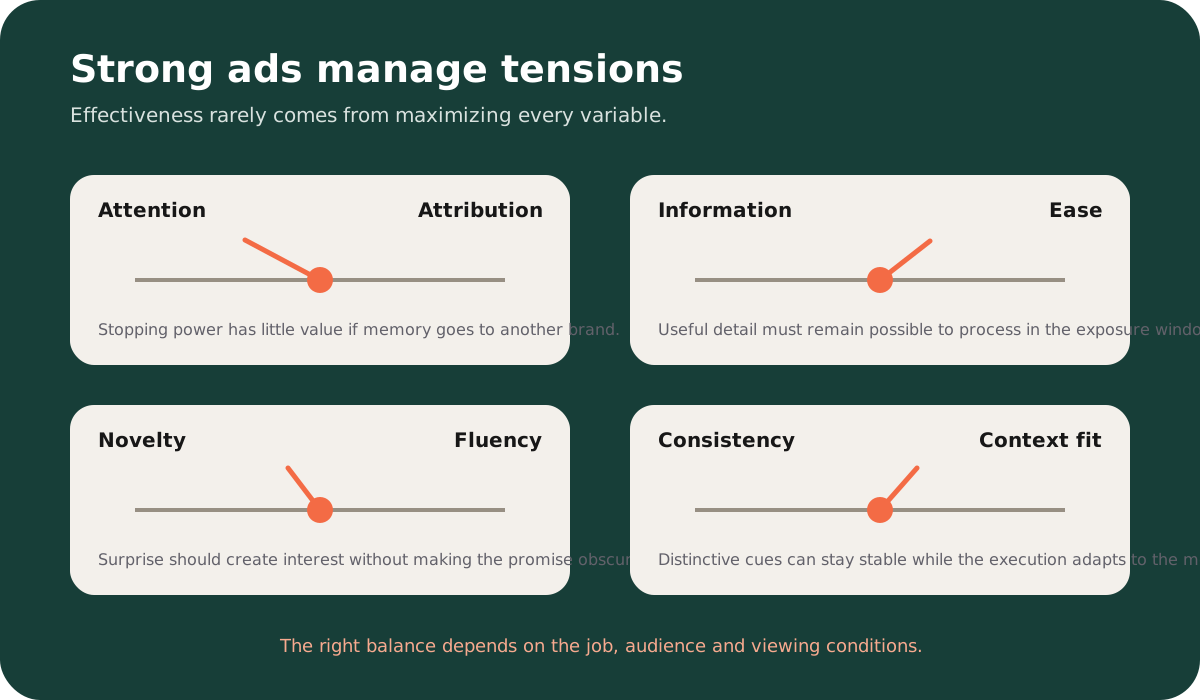
The qualities can pull against one another. Increasing novelty may improve stopping power while making the product harder to recognize. Adding substantiation may improve credibility while increasing reading demand. Enforcing identical layouts can support consistency while weakening a format that needs native pacing.
Resolve tensions from the objective. Protect non-negotiables such as accurate claims, accessibility and brand attribution. Then prioritize the response most necessary for this execution. Use testing to compare plausible balances rather than asking one version to maximize everything.
Google’s ABCD creative guidance—attract, brand, connect and direct—is a useful platform-oriented reminder that attention, brand presence, emotion and action should work together. It is not a universal recipe. The correct expression varies with the format and job.
How to evaluate whether an ad is effective
Start with observable evidence before judging taste. A practical review can follow six steps:
- Write the job. Define the audience, objective, placement and intended response in one paragraph.
- Recreate exposure. View the real asset at intended size, distance, duration, orientation and sound state.
- Map the first retrieval. Record what is noticed first, what message is available and whether the brand is linked to it.
- Inspect the 12-quality profile. Identify the strongest contributor, the constraint and any critical failure.
- Gather appropriate evidence. Use diagnostics, audience research or experiments according to the decision and risk. The pre-launch testing guide shows how.
- Connect to outcomes. Preserve version IDs and compare predictions with delivery, response and business results.
Do not average away critical failures. A high overall score cannot compensate for an unreadable safety instruction, misleading condition or absent brand attribution. Prioritize the few changes that improve the communication task without creating a larger problem elsewhere.
Optiks.ai structures this review across attention, hierarchy, readability, cognitive load, message, emotion, brand, color, composition, persuasion and context fit, then turns the diagnosis into creative analysis and action steps. The output is evidence for a decision, not a guarantee of market performance.
Worked example: one fictional campaign across three formats
Imagine Mora, a fictional botanical drink concentrate, is introducing a reusable bottle and refill system. The business objective is trial. The communication task is to establish that one compact refill makes several drinks with less packaging. The campaign appears as an outdoor poster, a mobile video and a retail display.
What works
A distinctive terracotta bottle appears in every format and sits next to the refill, supporting attribution and product understanding. One organizing idea—more drinks from less packaging—guides the imagery. Warm coral and deep green separate the system from a bright category while remaining coherent across placements.
What needs adaptation
The outdoor poster reduces the claim to one headline and a large product relationship because drivers have little time. The mobile video shows the refill mechanism in the first seconds, includes captions and introduces the brand during the demonstration. The retail display adds price, flavor choice and a concrete quantity because shoppers can inspect it at close range.
How the team tests it
A structured review checks visibility, brand linkage and claim clarity in each context. A short unprompted exposure test measures whether target customers identify the product system and advertiser. The team predefines a failure condition for any interpretation that overstates the environmental benefit. After launch, a holdout or credible comparison estimates incremental trial while diagnostic measures explain why one placement performed differently.
The campaign is coherent without being identical. Distinctive cues remain stable; information density and sequence change with the audience’s task. That is what format fit looks like in practice.
Frequently asked questions
What makes an advertisement effective?
An effective ad performs a defined job for a specific audience in real viewing conditions. It earns attention, communicates a clear and relevant promise, connects that meaning to the brand, provides a credible reason to respond and makes the intended response possible.
What are the most important elements of an effective ad?
The priority depends on the objective, but most effective ads need relevance, an attention entry point, clear hierarchy, readability, efficient processing, one organizing message, correct brand attribution, suitable emotion, credible proof, coherent execution, context fit and an appropriate next step.
Does every effective ad need a call to action?
No. Direct-response work usually needs an explicit action. Brand work may aim to create memory, meaning or future consideration. Every ad needs a defined intended response, but that response is not always an immediate click or purchase.
Can advertising creativity be measured?
Important parts can be measured: attention, comprehension, attribution, recall, emotion, credibility, consideration and behavior. No single score captures every purpose. Measures should follow the objective and be validated against outcomes where possible.
Are emotional advertisements more effective?
Emotion can support attention, memory and motivation when it fits the audience, promise and brand. An emotional scene that eclipses attribution or produces the wrong feeling can weaken performance. Relevance and linkage matter more than emotional intensity alone.
Research and references
- IAB: Attention Measurement Guidelines and resources
- IAB and Media Rating Council: Attention Measurement Guidelines
- W3C: Understanding Success Criterion 1.4.3, Contrast (Minimum)
- W3C: Accessibility principles
- Think with Google: The ABCDs of effective creative
- Think with Google: Tips for short-form video advertising
The Mora example is fictional. Claims, regulated disclosures, accessibility decisions and causal measurement should involve appropriately qualified specialists.
The best question is not “Is this a good ad?” Ask whether this execution, for this audience and placement, can produce the response the campaign needs—and what evidence would change your mind.